
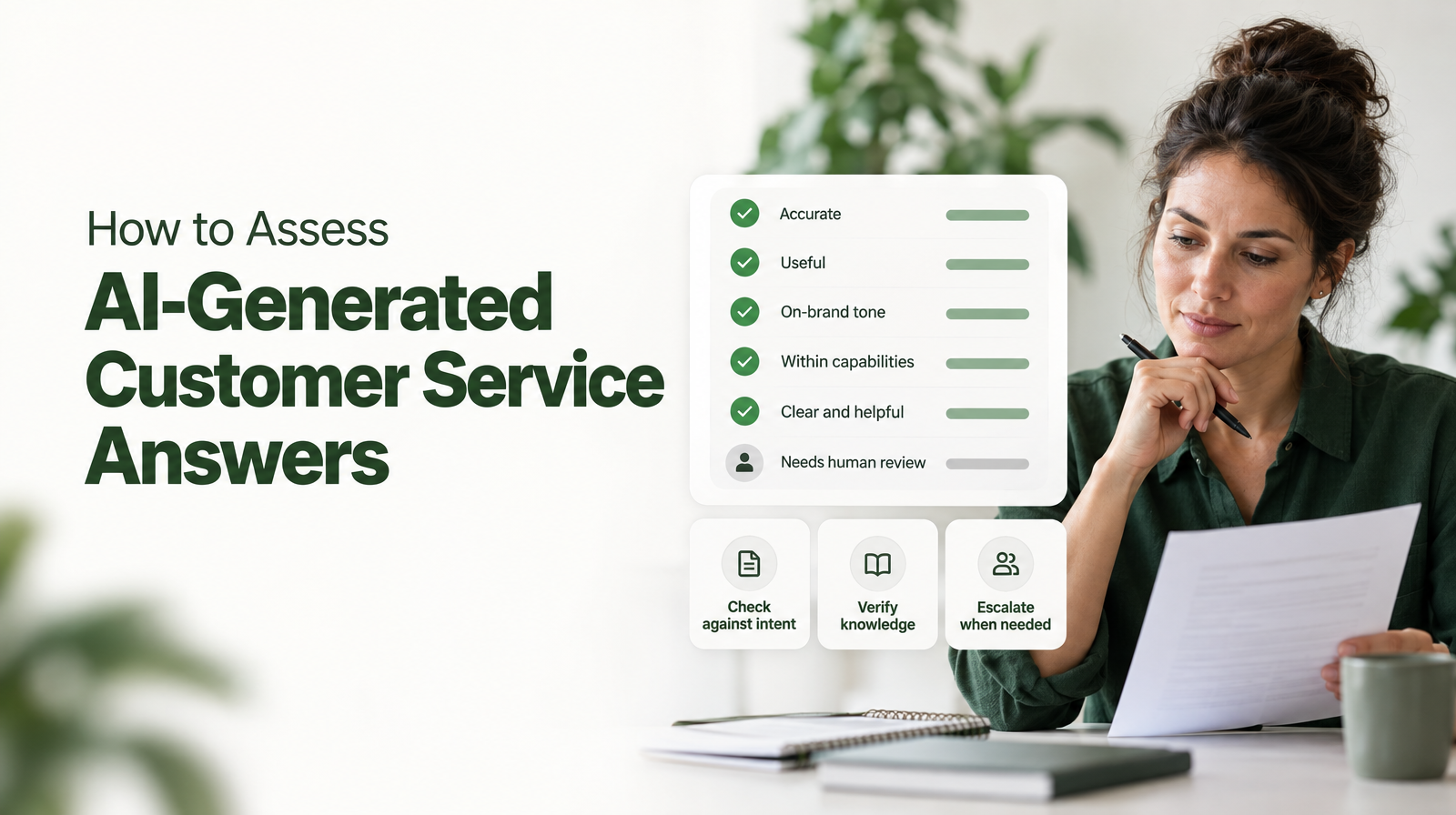
The most dependable way to assess an AI-generated customer service answer is to review the conversation in context, not the response speed alone. Check whether the answer understood the customer’s intent, stayed grounded in approved knowledge, remained within business-defined capabilities, was genuinely useful, used an appropriate tone, and recognised when human judgement was needed.
This conversation-first approach helps founders, operators and support leads evaluate AI customer support quality without relying on unsupported performance claims or vanity metrics.
What makes an AI-generated customer service answer dependable?
A dependable answer is not merely fluent or fast. It should help the customer move forward while remaining within the boundaries set by the business.
Review each answer against six questions:
- Did it understand what the customer was trying to achieve?
- Is the information supported by approved knowledge?
- Did it stay within the assistant’s authorised capabilities?
- Is the answer clear and useful to the customer?
- Is the tone appropriate for the business?
- Should a human have become involved?
These questions apply whether the answer concerns a straightforward request, an action involving live data or a situation that needs more context.
Speed and availability still matter for a team serving customers across different time zones. But an answer that arrives quickly and misinterprets the request can create more work rather than less. The quality of the answer remains the central object of review.
1. Identify the customer’s intended outcome
Begin with the customer’s message, before judging the AI response.
Customers do not always state their real objective directly. A question that appears to ask for information may actually be an attempt to decide what to do next. A request that sounds routine may depend on personal context or require a business decision.
Write down the customer’s likely intended outcome in one sentence:
“The customer wants to understand ___ so that they can ___.”
Then compare that outcome with the generated answer.
Ask:
- Did the answer respond to the question the customer meant to ask?
- Did it address the relevant context already provided?
- Did it ask for clarification when the request was genuinely ambiguous?
- Did it avoid answering a simpler, nearby question instead?
- Did it give the customer a sensible next step?
Illustrative situation
Imagine a customer asks a question that could refer to two different processes. An answer that confidently explains only one process may sound polished but still fail the customer. A better response might briefly identify the ambiguity and ask which situation applies.
This is why reviewing isolated sentences can be misleading. The same sentence may be useful in one conversation and inadequate in another.
2. Verify the answer against approved knowledge
The next step is to check whether the answer is grounded in information the business has approved for customer support.
The reviewer does not need to ask whether the response “sounds right”. Instead, look for the source of each important claim.
Check whether the answer:
- Reflects current approved business information
- Uses the terms and conditions the business has authorised
- Avoids inventing policies, commitments or exceptions
- Distinguishes known information from uncertainty
- Avoids presenting an unsupported assumption as a fact
- Includes only the detail needed for the customer’s situation
An answer can be grammatically excellent and still be unreliable if its central claim cannot be supported by approved knowledge.
For teams that need to improve the source material behind their support assistant, How to Build an Approved Knowledge Base for AI Support provides useful context on organising information for dependable customer answers.
A practical grounding test
Highlight the factual statements in the response. For each one, mark it as:
- Supported: clearly backed by approved knowledge
- Unclear: potentially correct, but the source is incomplete or ambiguous
- Unsupported: not established by the approved information
- Incorrect: conflicts with what the business has approved
This does not need to become a complicated scoring system. The purpose is to find the exact part of the answer that requires correction.
If the assistant does not have enough information to answer safely, a transparent limitation or clarification request is preferable to confident invention.
3. Review any action or implied authority
Some support conversations involve more than information. The assistant may act on live data through capabilities that the business controls.
These answers require an additional review. Consider both what the assistant said and what it implied it could do.
Ask:
- Was the requested action within the assistant’s defined capability?
- Did the response accurately describe what happened?
- Did it avoid claiming that an action was completed without confirmation?
- Did it avoid implying authority the business has not granted?
- Did it explain any limitation clearly?
- Should the request have been handled by a person?
The relevant question is not whether the assistant can perform as many actions as possible. It is whether the action is appropriate, controlled and accurately represented.
Illustrative situation
Suppose a customer asks the assistant to make a change involving live business information. A dependable answer should not imply that the change occurred merely because the request was understood. The review should establish whether the capability was available, whether it was within the business’s defined permissions and whether the result was communicated accurately.
For a deeper discussion of this operating principle, see Letting AI Support Act on Live Data Without Losing Control.
4. Distinguish a correct answer from a useful one
Correctness is necessary, but it is not sufficient.
An answer may contain accurate information while leaving the customer unsure what to do. It may list several possibilities without explaining which one applies. It may repeat general background instead of resolving the customer’s immediate concern.
Assess usefulness by asking:
- Can the customer understand the answer without internal business context?
- Does it address the immediate problem rather than adding unrelated detail?
- Does it make the next step clear?
- Does it explain necessary conditions without overwhelming the reader?
- Does it avoid sending the customer back to information they have already provided?
A useful answer is usually focused. It gives enough information to help the customer progress, while being honest about what remains uncertain.
A simple customer test
After reading the response, complete this sentence:
“The customer now knows to…”
If you cannot finish that sentence clearly, the answer may be accurate but not useful enough.
This test is particularly valuable for small teams because it exposes answers that appear successful in a system log but still create follow-up messages.
5. Review tone separately from factual reliability
Tone should be assessed, but it should not be confused with trustworthiness.
A warm, polite answer can still be wrong. A concise answer can still be useful and appropriate. Review tone as a separate dimension:
- Is the language clear and respectful?
- Does the level of confidence match the available information?
- Does the answer avoid exaggerated certainty?
- Does it sound consistent with the business’s voice?
- Is it calm rather than gimmicky or over-familiar?
- Does it acknowledge inconvenience or uncertainty where appropriate?
Coffey’s brand is positioned as premium, clear and reassuring. That does not mean every answer should sound elaborate. It means the response should avoid overhyped AI language and should not use a confident tone to disguise a knowledge gap.
For guidance on preserving consistency while automating support, see How to Keep Your Brand Voice When Automating Customer Support.
6. Decide whether human judgement was needed
Human escalation should be treated as part of quality, not automatically as a failure.
A customer’s situation may fall outside approved knowledge, involve ambiguity, require discretion or depend on context the assistant should not resolve alone. In those cases, the strongest answer may be one that recognises the limit and brings in the team.
During review, ask:
- Did the assistant recognise that the situation needed judgement?
- Did it avoid forcing a complex issue into a routine answer?
- Did it explain why a person should become involved?
- Did it preserve the customer’s context for the team?
- Did it avoid promising an unsupported response time?
- Did it remain useful while escalation was arranged?
Escalation that happens too late can make an answer misleading. Escalation that happens whenever a question is slightly unusual can make the assistant unnecessarily unhelpful. The appropriate standard is whether a person was needed for this situation.
When Should AI Support Escalate to a Human? A Clear Guide explores this decision in more detail.
A practical AI customer support quality checklist
Use this checklist when reviewing an individual conversation:
Customer intent
- What was the customer trying to accomplish?
- Did the answer address that intended outcome?
- Was clarification needed?
Grounding
- Which claims are supported by approved knowledge?
- Did the answer introduce anything the business has not approved?
- Did it communicate uncertainty appropriately?
Capability and control
- Did the answer involve an action or implied authority?
- Was that capability defined and permitted by the business?
- Was the result represented accurately?
Usefulness
- Is the answer direct?
- Is it understandable to someone outside the business?
- Does it give the customer a clear next step?
Tone
- Is the response respectful and calm?
- Does its confidence match the evidence?
- Is it consistent with the business voice?
Human judgement
- Did the situation require a person?
- Was escalation timely and clear?
- Did the assistant avoid making unsupported promises?
What should a small team record?
A lean team does not need to create an elaborate evaluation programme to learn from support conversations. Record enough detail to identify patterns and make a practical improvement.
For each reviewed conversation, capture:
- The customer’s intended outcome
- The type of request
- The answer’s main strength
- The specific problem, if there was one
- The relevant approved knowledge source
- Any capability or authority concern
- Whether clarification or escalation was needed
- The improvement to test next
Avoid recording only a general label such as “bad answer”. A useful note is specific:
“The response answered the policy question but did not distinguish between the two situations in the customer’s message. Add a clarification step before providing the process.”
That observation points to an improvement. It may require clearer approved knowledge, a narrower capability boundary, a better response instruction or a more deliberate escalation path.
Turn conversation reviews into improvements
When the same issue appears repeatedly, classify it before changing the system.
A pattern may indicate:
- Missing approved knowledge
- Ambiguous or outdated source material
- A response that is too broad
- An unclear capability boundary
- A missing clarification step
- An escalation rule that needs refinement
- Tone that creates false confidence
Do not assume that adding more information will solve every problem. Sometimes the right improvement is to narrow the assistant’s role or make its limitations clearer.
Review a small, deliberately selected set of conversations regularly. Include straightforward questions, ambiguous requests, capability-related interactions and situations where human judgement may be required. This gives the team a more useful picture than reviewing only successful, easy-to-answer conversations.
What dependable support looks like
AI customer support quality is best assessed through the relationship between customer intent, approved knowledge, business control, usefulness, tone and human judgement.
A dependable assistant does not need to appear capable of handling everything alone. It needs to be useful when automation is appropriate, remain within the capabilities the business defines and recognise when a person should take over.
That is the model behind Coffey. Coffey is an AI customer support assistant that never sleeps, answers using approved knowledge, acts on live data through capabilities the business controls and escalates to a human when needed.
For founders, operators and support leads, the key question is not simply, “Did the assistant reply?”
It is:
Did the answer help the customer while keeping the business informed and in control?
Review conversations against that standard, and AI customer support quality becomes something your team can examine, discuss and improve in practical terms.