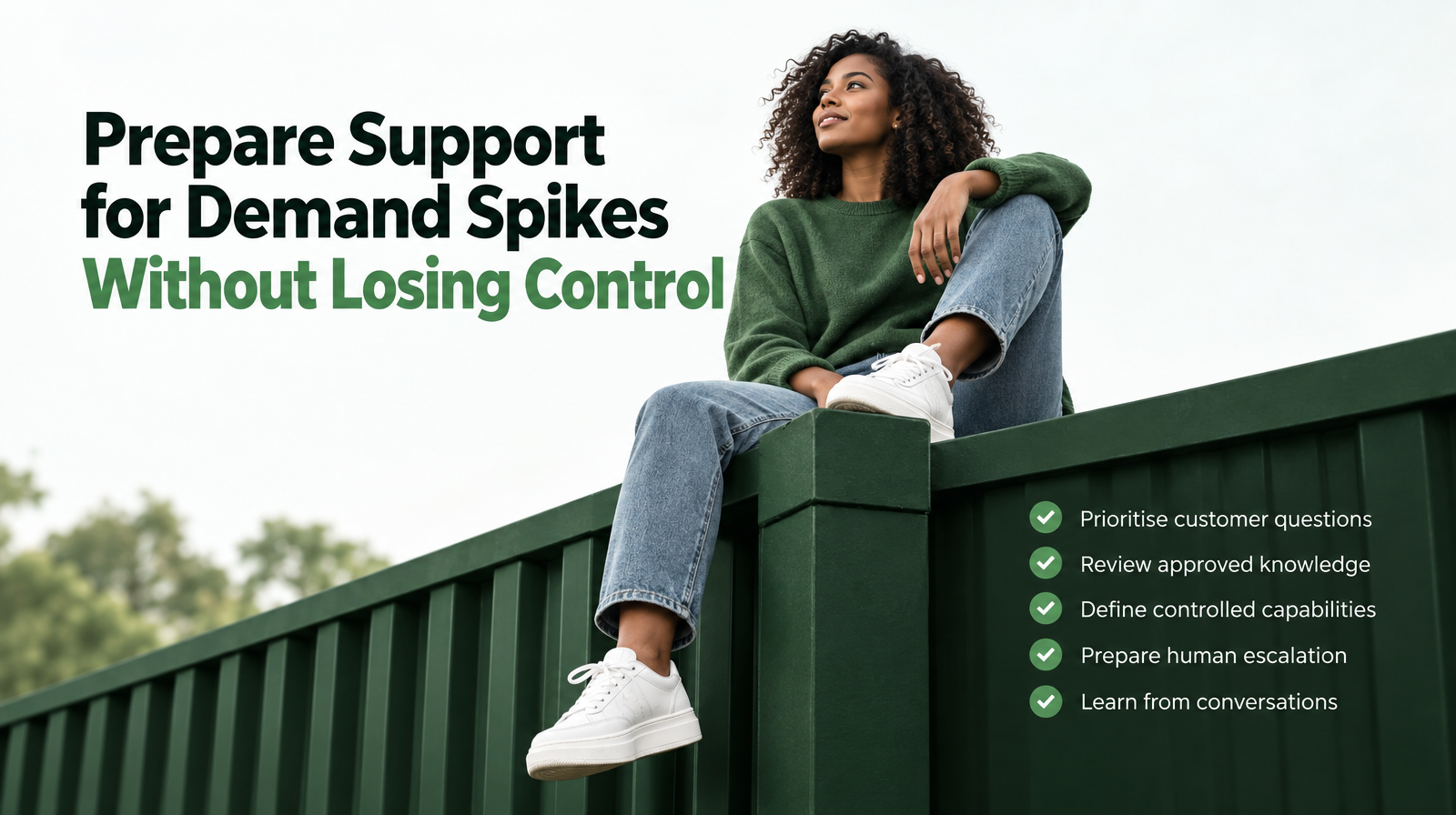

A customer support continuity plan defines how customers will receive dependable help when a small team is unavailable, occupied, working across time zones, or handling a complex case.
It does not require promising 24/7 human coverage. Instead, it sets clear boundaries around four decisions:
- What customers should expect.
- Which information may be used to answer them.
- Which actions are permitted.
- When a human takes responsibility.
For founders, operators, and support leads, this turns “always-on support” from a vague availability promise into a practical operating model. An AI customer support assistant such as Coffey can support that model by answering from approved knowledge, acting through business-controlled capabilities, and escalating when human judgement is needed.
What is a customer support continuity plan?
A customer support continuity plan explains how support will remain appropriate when the normal process is interrupted or stretched.
That interruption might happen because:
- The team has finished for the day.
- A founder is focused on another business priority.
- Several customers ask questions at the same time.
- Customers are contacting the business from different time zones.
- The relevant team member is away.
- A request requires information or judgement that has not been approved for automated handling.
Continuity is not simply the ability to send a response. A response can still be unhelpful if it is inaccurate, based on outdated information, outside the assistant’s authority, or unclear about when a person will become involved.
A useful plan therefore combines availability, accuracy, control, and responsibility.
Why small businesses need support continuity planning
Lean teams often rely on informal support processes. A founder may hold much of the product knowledge, while a small group shares an inbox or responds through several channels. This can work for a time, but it makes support vulnerable to individual availability.
Without a continuity plan:
- Routine questions may wait until the next available team member.
- Customers may not know whether their message has been received.
- Different team members may provide inconsistent guidance.
- Automated support may be expected to answer without a defined source of truth.
- Human attention may be consumed by questions that could have been answered from approved information.
- Complex cases may lack a clear route to someone accountable.
The answer is not to remove human support. It is to define where human support adds the most value.
A good continuity plan allows routine questions to keep moving while protecting time for situations that require context, judgement, or direct ownership.
The four decisions at the centre of the plan
1. Decide what customers should expect
Begin with the customer-facing promise.
Ask what a customer should understand when they contact the business outside normal team availability. For example:
- Can they ask common questions at any time?
- Will they receive information based on the business’s approved guidance?
- Can the support assistant perform any defined actions?
- What types of situation require a human?
- What should the customer do if the automated answer does not resolve the issue?
The wording should be realistic. Dependable support does not mean guaranteed immediate human resolution. It also does not mean every question will be resolved automatically.
A clear expectation might be that customers can receive assistance with common questions beyond staff hours, while unusual or judgement-sensitive matters are directed to the team.
Avoid promising “instant human support” unless the business genuinely provides it. Continuity means customers have a defined support path, not that every part of that path is continuously staffed by people.
2. Define the approved knowledge
The second decision is what information the assistant may use when answering customers.
For a small business, approved knowledge might include:
- Product or service explanations.
- Published customer guidance.
- Frequently asked questions reviewed by the team.
- Business policies.
- Instructions for common customer requests.
- Boundaries describing what support cannot confirm or decide.
The goal is not to provide as much information as possible. The goal is to establish a trustworthy, relevant foundation for answers.
The business should also decide who reviews this information and when. Knowledge maintenance becomes especially important when:
- A product or service changes.
- A policy is revised.
- Customer instructions are updated.
- A recurring question reveals confusion.
- The team discovers that an answer no longer reflects current practice.
A simple maintenance routine is enough to begin:
- Record the business change.
- Identify the support answers it could affect.
- Update the authoritative information.
- Review the customer-facing guidance.
- Remove or replace outdated instructions.
- Test representative questions again.
Coffey’s support model is based on answering from the business’s approved knowledge. That makes the business’s review process an important part of continuity planning. An always-available answer is only useful when the information behind it remains intentional and current.
3. Separate answers from actions
An answer and an action are different forms of support authority.
A customer might ask for an explanation that can be provided from approved knowledge. Another request might require access to current information or an action affecting the customer’s situation.
For each common support need, ask:
- Is an explanation enough?
- Does the request require live information?
- Would an action change customer or business data?
- Has the business explicitly permitted that action?
- Does a person need to review it first?
This distinction prevents “automation” from becoming an unclear grant of authority.
Coffey can act on live data through capabilities the business controls. The relevant planning question is not simply whether an action is technically possible. It is whether the business has deliberately defined that capability, its boundaries, and the situations in which it may be used.
A practical support plan should therefore maintain separate lists for:
- Answerable questions: the assistant can respond using approved knowledge.
- Controlled actions: the assistant may act only through capabilities the business has defined.
- Human-owned situations: the assistant should not decide or act without team involvement.
This separation makes the operating model easier to explain, test, and revise.
4. Define when a human takes responsibility
A continuity plan should make the stopping point as clear as the starting point.
Human escalation may be appropriate when:
- The customer’s situation is unusual or ambiguous.
- The answer is not covered by approved knowledge.
- The customer disputes or challenges the response.
- The request involves sensitive judgement.
- A requested action falls outside controlled capabilities.
- The assistant cannot establish enough information to respond responsibly.
- The customer explicitly needs or requests team involvement.
Escalation does not have to imply that a human is available immediately at every hour. The plan should describe the next step accurately, including any relevant expectation about when the team will review the matter.
The key distinction is between automated availability and human ownership. An assistant can remain available for questions while the business retains responsibility for situations that require judgement.
Map support situations before choosing automation
A useful continuity plan starts with the questions customers actually ask, not with a list of imagined features.
Create a simple map like this:
| Support situation | Approved answer? | Controlled action? | Human responsibility? |
|---|---|---|---|
| Common question covered by current business guidance | Yes | No | Usually not |
| Question requiring current business information | Possibly | Only if explicitly defined | Depends on the boundary |
| Request outside approved knowledge | No | No | Yes, or provide a clear next step |
| Unusual or judgement-sensitive case | Not always | Possibly | Yes |
| Request covered by a permitted capability | Yes, if defined | Yes | Follow the business rule |
This table helps expose gaps early.
If many routine questions lack approved answers, the immediate need may be better knowledge maintenance. If many requests require human judgement, the business should preserve enough capacity for those cases rather than treating every conversation as suitable for automation.
The point is not to maximise the number of automated interactions. It is to create a dependable division of responsibility.
Build a testing routine
Testing should happen before the plan becomes part of everyday support, and again when the business changes.
Use realistic customer questions and check whether:
- The assistant identifies the relevant approved information.
- The response reflects the business’s intended guidance.
- The answer avoids unsupported certainty.
- Outdated instructions are not being relied upon.
- Controlled capabilities are limited to their defined purpose.
- Requests outside those capabilities receive an appropriate boundary.
- Unclear or sensitive cases move toward human involvement.
- Customers can understand what happens next.
- The team can review and take ownership of escalated conversations.
Test more than straightforward questions. Include questions with missing information, ambiguous wording, outdated assumptions, requests for action, and challenges to a previous answer.
A response that is fast but overconfident is not a successful continuity outcome. Testing should examine whether the support experience remains useful and controlled when the question is not simple.
A customer support continuity checklist
Before relying on the plan, confirm that the team can answer yes to these questions:
- Have we defined what customers can expect outside normal staff availability?
- Have we avoided implying 24/7 human coverage if we do not provide it?
- Is there a clearly approved source for common support answers?
- Do we know who reviews that information when the business changes?
- Have we separated explanations from actions on live data?
- Are permitted capabilities explicitly defined?
- Do we know which topics remain human-owned?
- Is the escalation route accurate and understandable?
- Have we tested routine, ambiguous, sensitive, and out-of-scope questions?
- Can the team review and improve the plan over time?
- Does the plan keep human responsibility visible?
If several answers are no, the next step is probably to clarify the operating model before adding more automation.
How Coffey fits into a continuity plan
Coffey is an AI customer support assistant that never sleeps, built for small businesses and lean teams that need support beyond the hours their staff can personally cover.
Its role fits the four-part continuity model:
- It answers using the business’s approved knowledge.
- It can act on live data through capabilities the business controls.
- It supports customer questions across different schedules and time zones.
- It escalates to the team when a human is needed.
Coffey does not replace the business’s human support responsibility. The team remains responsible for deciding what information is approved, which capabilities are permitted, and when a person should take over.
That boundary is central to dependable automation. Always-on support should not mean open-ended automation. It should mean that customers have a clear support layer available when the team is unavailable, while authority remains defined and human judgement remains available.
Final takeaway
A customer support continuity plan helps a small business remain dependable without promising continuous human coverage.
The strongest plans connect:
- Realistic customer expectations.
- Current, approved knowledge.
- Clearly controlled actions.
- A practical route to human escalation.
- Testing and review when the business changes.
For lean teams, this approach makes support continuity manageable. Routine questions can receive useful assistance beyond staff availability, while complex situations remain within the team’s responsibility.
Coffey supports that operating model with AI customer support that never sleeps, grounded in approved knowledge, controlled capabilities, and human involvement when it matters.