
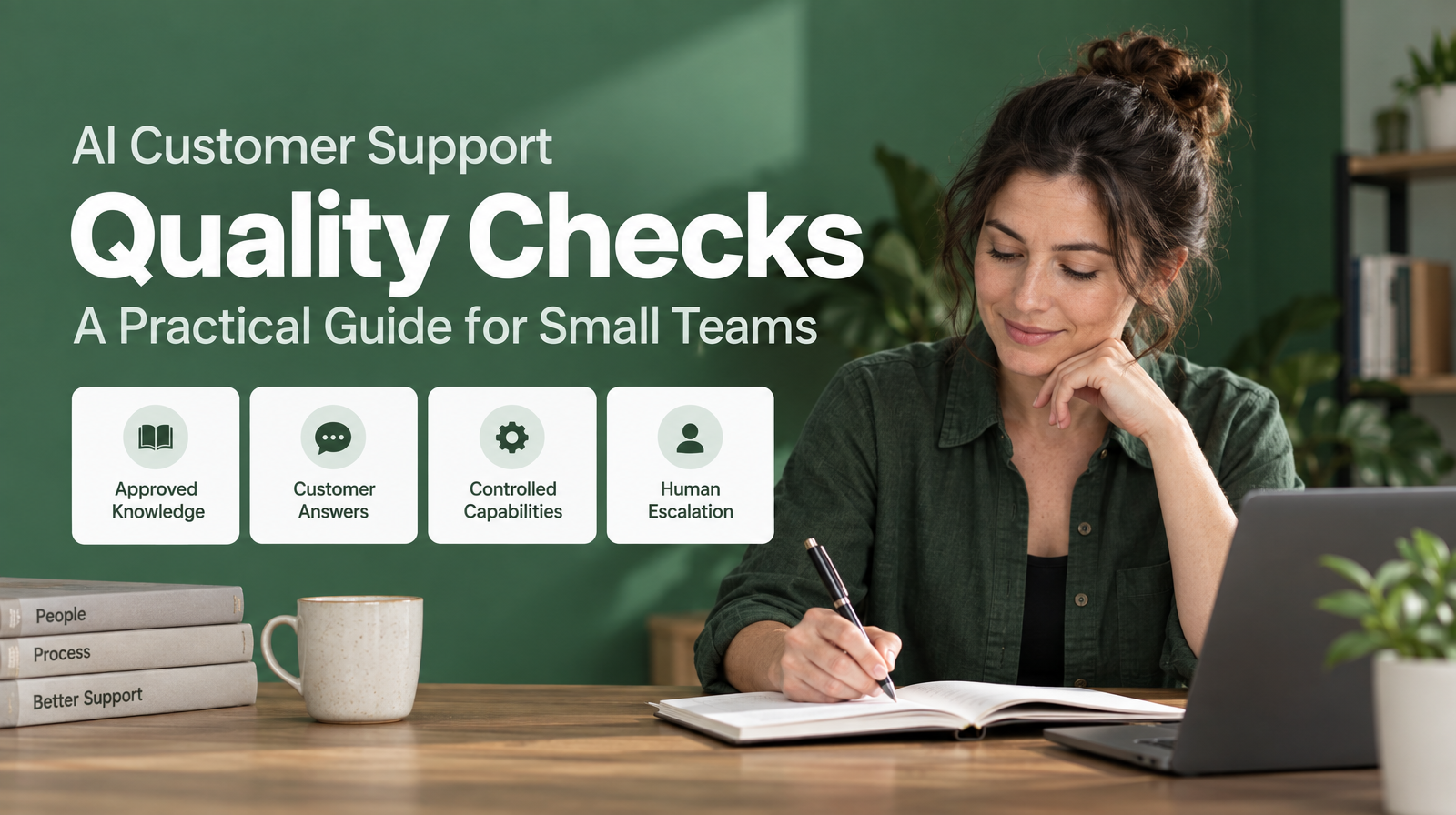
AI customer support is often treated as a launch decision. A business chooses a system, provides information, defines what it can do, and then expects the support experience to remain reliable. The more useful way to think about it is as an ongoing operating practice.
Customer questions change. Business information changes. Some answers become outdated. A capability that was appropriate for one type of request may need closer review in another context. And even a useful automated answer can still be the wrong answer if the situation requires human judgement.
For small businesses and lean teams, regular quality checks create a practical middle ground. They help the business keep customer assistance available without assuming that automation should operate without oversight. This guide explains what to review, how to structure a lightweight quality process, and which questions can reveal when AI customer support needs adjustment.
What does AI customer support quality mean?
AI customer support quality is not simply how quickly an assistant replies. A quality review should consider whether the support is:
- Grounded in information the business has approved
- Relevant to the customer’s actual question
- Within the capabilities and permissions the business has defined
- Clear about when a person should become involved
- Consistent with the business’s intended support standard
- Useful without making the business appear to promise more than it can deliver
This definition matters because a fluent answer is not automatically a dependable answer. An AI assistant can sound confident while relying on information that is incomplete, outdated, or unsuitable for the situation.
For a lean team, the goal is not to inspect every interaction manually. The goal is to establish a clear review discipline that helps the team identify patterns, update its approved source material, and keep responsibility visible.
Why quality checks matter after launch
The first version of an AI support process is based on what the business knows at that point. Over time, the surrounding context changes.
A business may revise its policies, change how it handles requests, or introduce a new operational capability. Customers may also ask questions in ways the team did not anticipate. A support answer that was once appropriate may become ambiguous when the underlying business information changes.
Without a review process, small problems can remain difficult to see. A team may notice an individual answer only when a customer points it out. By then, the issue may be less about one response and more about a missing source, an unclear boundary, or an escalation decision that was never defined.
Regular quality checks give the team a way to ask:
- Is the assistant using the information we want it to use?
- Is it staying within the actions we have permitted?
- Is it helping with routine questions while leaving judgement-heavy matters to people?
- Are customers receiving answers that are clear enough to act on?
- What should we change in the source material or support rules?
These questions keep quality connected to business responsibility rather than reducing it to a technical exercise.
The four areas to review
A practical quality check can be organised around four connected areas: knowledge, answers, capabilities, and escalation.
1. Review the approved knowledge
Start with the information that the assistant is expected to rely on. Look for:
- Information that is no longer current
- Statements that conflict with one another
- Important customer questions that have no clear answer
- Instructions that are too broad to apply consistently
- Terms that the business uses internally but customers may not understand
- Policies that describe an exception without explaining how it should be handled
The purpose of this review is not to create a larger collection of documents for its own sake. It is to make the intended support standard easier to apply. A smaller, clearer source can be more useful than a large collection of material that contains conflicting guidance. The team should be able to explain which information is authoritative and who is responsible for keeping it current.
Coffey’s support model is built around answers grounded in a business’s approved knowledge. That makes the quality of the source material an important part of the customer experience, not merely an internal documentation task. For a deeper foundation, see How to Build an Approved Knowledge Base for AI Support.
2. Review the customer-facing answers
The next question is whether the resulting answers are useful to the person asking for help. A review can examine whether answers:
- Address the customer’s actual question
- Use language that is clear and appropriately specific
- Avoid unnecessary certainty
- Give the customer a sensible next step when one is available
- Distinguish between general information and a matter requiring team judgement
- Avoid making the customer repeat information unnecessarily
It is useful to review answers as a customer would experience them, rather than only checking whether each sentence is technically accurate. For example, an answer can contain correct information but still leave the customer unsure what to do next. Another answer may be accurate for a routine question but unsuitable when the customer’s situation includes an exception.
The standard should therefore include both factual grounding and practical usefulness. A good review prompt is:
If I were the customer, would this answer help me understand my situation and decide what to do next?
That question keeps the review focused on customer support rather than on how impressive the language sounds.
3. Review controlled capabilities
Some customer requests need more than an explanation. They may involve an action based on live business data or another capability the business has chosen to make available. This is where quality review should examine not only what the assistant says, but what it is permitted to do.
For each capability, the team should be able to describe:
- What customer need it is intended to support
- Which types of request are appropriate
- What information or authority it depends on
- Which situations should remain with a person
- What the customer should be told when the capability cannot complete the request
The aim is not to make automation incapable of helping. It is to make its role understandable and bounded. Coffey acts on live data through capabilities the business controls. The business remains responsible for deciding which capabilities are available and where human involvement is required. That distinction is central to trustworthy automation.
The team should periodically ask whether each capability still reflects the way the business wants to serve customers. If the answer is unclear, the capability needs review before it becomes a source of avoidable confusion. You can explore this topic further in Letting AI Support Act on Live Data Without Losing Control.
4. Review escalation decisions
A quality process should also examine when the assistant involves a human. Escalation is not evidence that automated support has failed. In many situations, it is the correct outcome. A customer may need context, judgement, accountability, or a decision that the business does not want automated support to make.
Review whether escalation is clear for situations such as:
- The approved knowledge does not provide a dependable answer
- The customer’s situation is unusual or ambiguous
- The request involves a decision that needs human judgement
- The available capability cannot complete the request safely or appropriately
- The customer needs a person to take responsibility for the matter
The team should also consider the customer’s experience during escalation. The transition should not create the impression that the customer has reached a dead end. Where possible, the support process should make clear why a person needs to become involved and what information the team will need to continue.
Coffey is designed to escalate to a team when a human is needed. That gives a lean business a way to combine always-on assistance with human responsibility, rather than treating the two as competing choices. For a more focused explanation of escalation criteria, read When Should AI Support Escalate to a Human? A Clear Guide.
A lightweight review routine for lean teams
A quality process does not need to become a large compliance programme. Small teams can begin with a repeatable review routine.
Step one: Choose a review window
Set a regular point at which someone reviews representative customer-support interactions. The interval should be realistic for the team’s capacity. A process that is too demanding will be difficult to maintain. The important principle is consistency. A modest review performed regularly is more useful than a detailed review that happens only once.
Step two: Review different kinds of questions
Do not examine only the easiest or most successful conversations. Include a useful range of situations, such as:
- Routine information requests
- Requests that depend on approved business information
- Requests involving a controlled capability
- Questions where the customer’s intent is unclear
- Conversations that needed human escalation
This gives the team a clearer view of where the support process is dependable and where it needs refinement.
Step three: Record the type of issue
When a response needs improvement, classify the reason rather than only rewriting the answer. For example, the issue may relate to:
- Missing approved knowledge
- Conflicting source information
- Unclear wording
- An overly broad capability
- An escalation point that was not defined
- A customer question that requires more context
This helps the team fix the underlying support process. Otherwise, it may repeatedly correct individual answers without addressing the source of the problem.
Step four: Assign ownership
Every improvement should have an owner. That does not mean one person must manage all support quality permanently. It means the team should know who is responsible for:
- Updating approved information
- Reviewing capability boundaries
- Clarifying escalation decisions
- Checking whether the customer-facing language reflects the business’s intended standard
Clear ownership prevents quality work from becoming an assumption that someone else is handling it.
Step five: Recheck after changes
When the business updates its approved knowledge or changes a capability, review related customer questions again. This is especially important when a change affects more than one part of the support experience. A new piece of information may alter an answer, a customer’s next step, or the point at which a human should become involved. The goal is not to create a perfect, permanent system. It is to make change visible and reviewable.
What not to use as your only quality signal
Some signals are easy to notice but incomplete on their own.
Speed
A fast response can be useful, but speed does not show whether the answer is grounded, relevant, or appropriate for the situation.
Confident language
A polished answer can still be unsuitable if it goes beyond approved information or overlooks the need for human judgement.
Automation volume
A support assistant handling many routine questions does not, by itself, show that the support experience is working well. The business still needs to understand whether the assistance is useful and within its intended boundaries.
Absence of complaints
Customers do not always report unclear or incomplete support. A quiet support channel is not proof that every answer is dependable.
The stronger approach is to combine customer usefulness, approved knowledge, controlled capability, and appropriate human involvement in one review.
How Coffey fits into an ongoing quality approach
Coffey is an AI customer support assistant that never sleeps. It is built for small businesses and lean teams that need customer assistance to remain available around the clock without claiming that automation should replace human teams.
Its support model brings together four principles:
- Answers grounded in the business’s approved knowledge
- Capabilities and permissions defined by the business
- Support that remains available across time zones
- Escalation to the team when a human is needed
These principles give a small team a practical basis for reviewing quality. The question is not simply whether Coffey answered. The question is whether the answer, action, or escalation reflected the support standard the business intended to provide. That is the difference between treating AI support as a set-and-forget tool and treating it as a dependable support layer.
A final checklist
Use the following questions during a regular review:
- Is the approved knowledge current and internally consistent?
- Did the answer address the customer’s actual question?
- Was the language clear without making unsupported claims?
- Did the assistant stay within the capabilities and permissions the business defined?
- Was a human involved when context, judgement, or accountability required it?
- Did the customer receive a useful next step?
- Does the issue point to a missing source, unclear rule, or capability boundary?
- Is someone responsible for making the necessary improvement?
- Has the updated process been reviewed against related customer questions?
If the answer to several of these questions is unclear, the next step is not necessarily to rebuild the support process from scratch. It is to return to the four review areas—knowledge, answers, capabilities, and escalation—and