
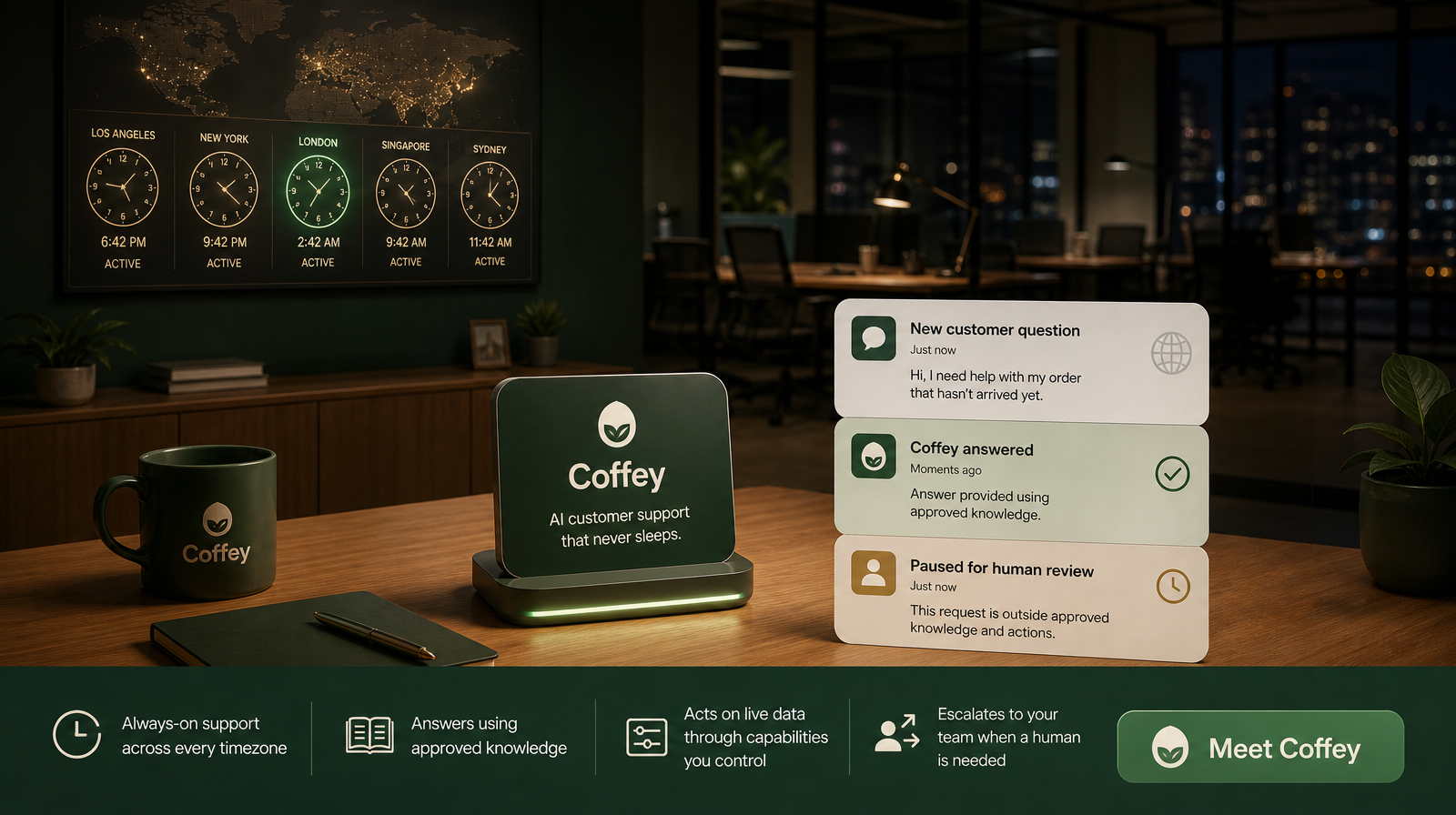
AI customer support and traditional chatbots can both answer customer questions, but they are not necessarily the same kind of system. A traditional chatbot often follows fixed flows or predefined responses. AI customer support is a broader support model that can use approved business knowledge, work through controlled capabilities, remain available outside team working hours and escalate to a person when human judgement is needed.
For small businesses and lean teams, the right choice depends on the questions customers ask, the information behind the answers, the actions the system may need to take and the role people should continue to play.
AI customer support vs chatbot: the practical difference
The word chatbot describes a conversational tool. It does not, by itself, explain how that tool works or what it can safely do.
A traditional chatbot may guide a customer through predefined options, provide fixed responses or handle a narrow set of predictable questions. This can be sufficient when the support experience is simple and highly structured.
An AI customer-support assistant is intended to operate as a wider support layer. Depending on the product and its configuration, it may:
- Answer questions using business-approved knowledge
- Respond to differently worded versions of recurring questions
- Use live data through capabilities the business defines and controls
- Remain available when the team is not actively monitoring support
- Escalate conversations that need human judgement
These are evaluation criteria, not automatic features of every product marketed as “AI customer support.” The product label is only a starting point. A small business should verify what the specific system knows, what it can access, what it can do and when it involves a person.
A side-by-side comparison
| Evaluation area | Traditional chatbot | AI customer support assistant |
|---|---|---|
| Response scope | Often focused on fixed flows, predefined questions or narrow tasks | May support a broader range of recurring customer questions |
| Knowledge | Commonly relies on scripted or configured responses | Can be grounded in knowledge the business approves, depending on the product |
| Language and phrasing | Works best when customer inputs fit expected paths | May handle varied phrasing, but this should be tested rather than assumed |
| Live information | May not access current business information | May use live data through capabilities the business explicitly controls |
| Availability | Can be available whenever the tool is running | Can provide an always-on support layer, depending on the service |
| Human involvement | May route customers to a team member through a predefined path | Can be designed to escalate when a human is needed |
| Business ownership | Usually defined through scripts, flows and configuration | Should include clear control over approved knowledge, capabilities and escalation |
The distinction is not “old technology versus new technology.” A traditional chatbot can be the better fit for a narrow, predictable support task. AI customer support can be more suitable when the business needs a broader, knowledge-grounded support role.
When is a traditional chatbot sufficient?
A traditional chatbot may be sufficient when the customer journey is narrow and easy to map.
For example, a business might need to direct visitors to one of a few support areas, answer a small number of standard questions or guide customers through a fixed process. If the expected conversations are predictable, predefined flows can offer a clear and controlled experience.
A traditional chatbot is more likely to fit when:
- Customers usually choose from a limited set of options
- The required answers are short and stable
- The business does not need the system to use live information
- There is little variation in how customers phrase their questions
- Human escalation can follow a simple, clearly defined route
This approach can also make ownership straightforward. The team can review the configured responses and update the relevant paths when information changes.
The limitation is that fixed-flow systems may become less useful when customers ask questions outside the expected journey. That is not a universal flaw; it is a consequence of a system designed around predefined options. The business should decide whether that narrowness is a useful control or an obstacle to the support experience it wants to provide.
When should a small business consider AI customer support?
AI customer support may be a better fit when customers ask recurring questions in different ways and the team wants those questions answered from approved business information.
This is especially relevant to small businesses and lean teams that field questions around the clock but do not have staff for continuous human support. The need is not necessarily to automate every conversation. It may be to provide a dependable first layer of assistance while keeping human attention available for exceptions and judgement-based work.
Consider AI customer support when:
-
Questions recur but are not always phrased the same way.
Customers may seek the same information using different words. A support assistant should be assessed on how well it handles the business’s real question patterns, not generic demonstrations. -
The business has information it wants to approve for customer use.
The assistant should be grounded in knowledge the company has deliberately selected rather than treated as an unrestricted authority. -
Some answers require current information.
If customers need live data, verify whether the specific product can access it through a capability the business controls. -
The team needs support coverage beyond its working hours.
An always-on support layer can help make assistance available across time zones without suggesting that a human team is present at every moment. -
Some requests should reach a person.
The system should have a defined role in relation to human support rather than being positioned as a replacement for the team.
Why approved knowledge matters
An AI system can produce a confident-sounding response without that response necessarily reflecting the business’s intended position. For customer support, fluency is not the same as authority.
Approved knowledge gives the business a basis for deciding what information should guide customer-facing answers. It helps the team establish which policies, explanations or service details are appropriate to use. It also makes the support model easier to discuss internally: the business remains responsible for the information it approves, while the assistant operates within that foundation.
Before choosing a product, ask:
- What counts as approved knowledge?
- Who decides what can be used in customer answers?
- How are outdated or unsuitable answers identified?
- Can the business clearly distinguish approved information from general generated content?
- What happens when the available knowledge does not answer the customer’s question?
These questions do not guarantee a particular outcome, but they expose whether the product supports the level of ownership a small business requires.
Can AI customer support use live data without unrestricted access?
It can, but the specific capability and control model must be verified for the product being considered.
There is an important difference between an assistant answering from approved knowledge and an assistant acting on live data. The first concerns the information used to form a response. The second concerns access to current business information or a defined business capability.
A small business should not assume that an AI assistant needs unrestricted access to be useful. Instead, assess:
- Which live information is actually needed?
- What capability would provide it?
- Who defines and controls that capability?
- What should the assistant be unable to access or change?
- Which requests should still be passed to a human?
This distinction is central to a controlled support model. Current information can be useful, but access should remain aligned with the business’s intended scope.
Human escalation is part of the support model
Human escalation should not be treated as evidence that automation has failed. It is a way to assign different kinds of work to the right support layer.
Routine questions may be suitable for an AI assistant. Other conversations may depend on context, discretion, exceptions or decisions that the business wants a person to make. In those cases, the assistant should provide a clear route to the team.
A useful escalation model defines:
- The kinds of questions the assistant can answer
- The circumstances in which it should stop
- The information or context the team needs when taking over
- Who owns the final judgement
- How customers are told that a person is becoming involved
For a deeper look at this decision, read When Should AI Support Escalate to a Human? A Clear Guide.
The key principle is simple: always-on availability does not require open-ended authority. An assistant can remain available while still recognising that some requests belong with the human team.
Does AI customer support replace a human support team?
For a small business, AI customer support should generally be evaluated as a support layer, not automatically as a replacement for human support.
People may still be responsible for nuanced customer conversations, judgement-based decisions, exceptional situations and the parts of service where business understanding matters most. AI can help make routine assistance more consistently available, but the business should decide where human ownership remains essential.
This is also why capability boundaries should be defined before a system is used with customers. How to Set Up AI Customer Support Boundaries Before You Go Live offers a practical companion to this comparison.
A buyer’s checklist for small businesses
Before choosing between a traditional chatbot and an AI customer-support assistant, work through this checklist:
Support questions
- What questions do customers ask repeatedly?
- Are those questions narrow enough for fixed flows?
- Do customers use varied wording or ask follow-up questions?
- Which questions should always involve a person?
Knowledge
- What information is approved for customer-facing answers?
- Who owns that information?
- How will the team review changes?
- What should happen when no approved answer is available?
Capabilities
- Does the assistant need current information?
- Which live-data capabilities are necessary?
- Can the business control what the assistant is allowed to access or use?
- Is answering separate from taking an action?
Availability
- Do customers need help outside the team’s working hours?
- Are customers asking questions across multiple time zones?
- Would an always-on first layer improve the support experience?
Human involvement
- When should the assistant escalate?
- Which team member or function should receive the conversation?
- What level of human judgement must remain with the business?
- Is the product being evaluated as an assistant or as an unsupported replacement for the team?
The answers will usually reveal the appropriate direction more clearly than a product demo alone.
How Coffey fits this comparison
Coffey is an AI customer support assistant for small businesses and lean teams that field customer questions around the clock but lack staff for continuous human support.
Coffey is designed around four verified principles:
- It never sleeps, providing an always-on support layer.
- It answers using knowledge the business approves.
- It acts on live data through capabilities the business controls.
- It escalates to the team when a human is needed.
That makes Coffey relevant to businesses looking beyond a narrow scripted chatbot but still wanting clear ownership over knowledge, capabilities and human judgement. It is not positioned as a replacement for human teams. Its role is to extend support availability while the business remains responsible for the boundaries behind the experience.
Final takeaway
The choice between AI customer support and a traditional chatbot is not a contest with one universal winner.
A traditional chatbot may be sufficient for narrow, predictable interactions built around fixed responses or flows. AI customer support may be a better fit when a small business needs broader support for recurring questions, approved-knowledge answers, controlled access to live data, availability across time zones and a clear route to human involvement.
Evaluate the operating model, not just the product label. Ask what the system knows, what it can do, who controls those inputs and when a person should take over.
For an always-on support layer built around those principles, explore Coffey at Coffey.cx.