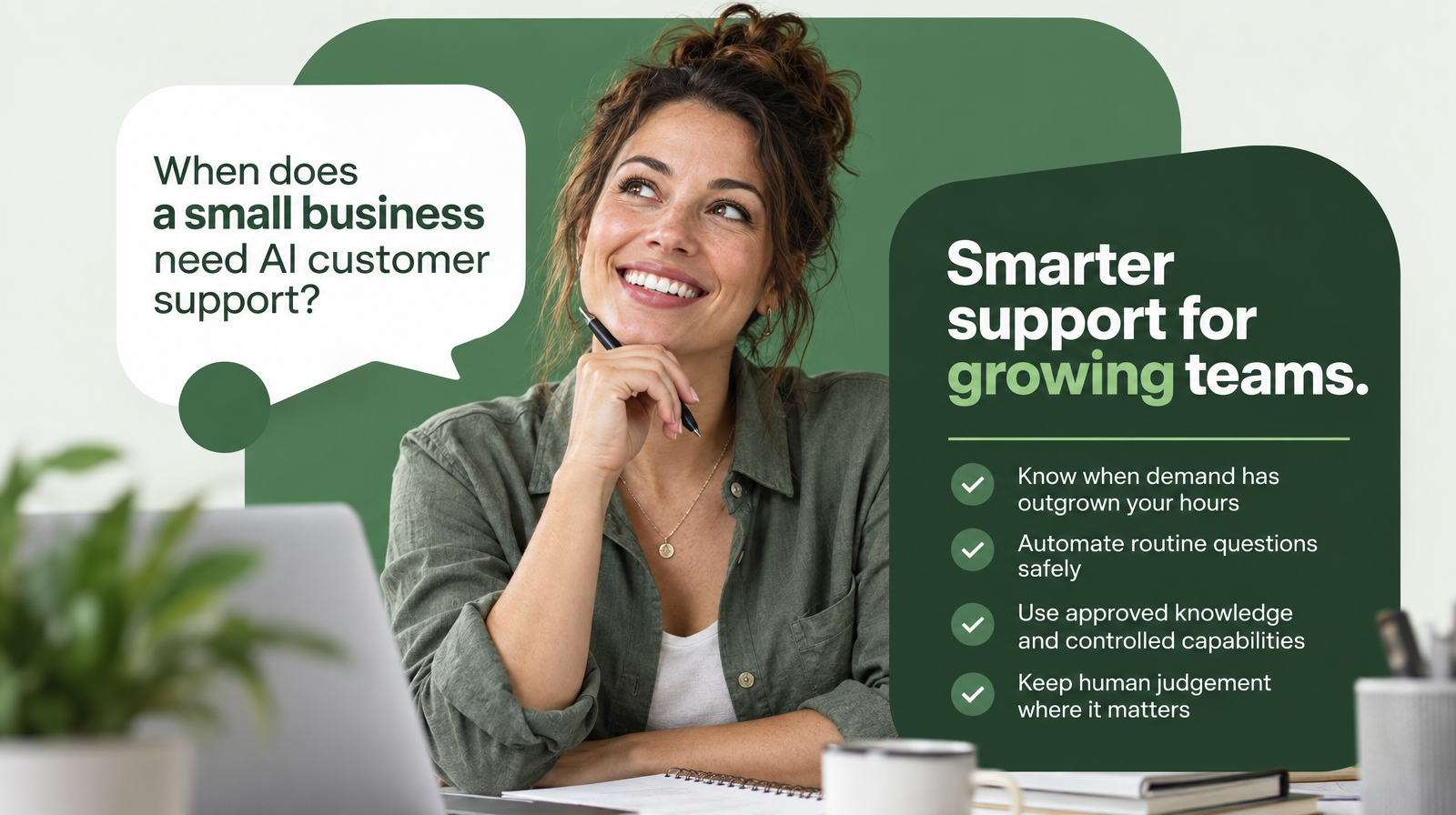
A small business needs AI customer support when customer questions consistently arrive outside the hours its team can cover, when the same routine questions keep consuming the team's limited attention, and when delayed or inconsistent answers start costing the business the trust it worked to build. The signal is rarely dramatic. It accumulates quietly: an overnight queue that greets you every morning, a founder answering shipping questions instead of running the business, two support leads giving two slightly different versions of the same policy.
This guide helps founders, operators, and support leads at small businesses and lean teams recognize that threshold, decide which requests AI should handle, and define the controls — approved knowledge, bounded capabilities, and human escalation — that make the support worth trusting.
The Operational Signs Your Team Has Been Outgrown
Customer support demand rarely becomes unmanageable all at once. It outgrows a lean team gradually, and the signs are operational, not emotional. Look for these patterns in a normal week:
Recurring overnight and weekend demand. You serve customers across regions, so questions arrive while your team sleeps. Every morning starts with a backlog that sets the tone for the day — and every customer in that backlog waited hours for an answer that may have taken thirty seconds to give.
The same questions, repeatedly. A large share of your volume is routine: order status, return policy, how a feature works, whether you ship somewhere. These questions have clear, documented answers. They consume human time without requiring human judgement.
Delayed resolutions on simple matters. When a lean team is busy, even easy questions wait. The customer experience degrades not because anyone did anything wrong, but because there are more questions than hours.
Support crowding out substantive work. The founder or support lead spends the day reacting to the queue instead of improving the product, closing sales, or handling the complex cases that genuinely need them.
Inconsistent answers. Different team members answer the same question differently, or the same person answers it differently depending on how busy they are. This is not a discipline problem. It is a capacity problem: humans under load improvise.
Requests that need action, not just answers. Customers increasingly ask the business to do something — check a status, update a detail — and each request interrupts someone's focus.
If three or more of these describe your week, your support demand has outgrown your team's available hours. Hiring is one response, but it is slow, expensive, and does nothing for the 2 a.m. question from another time zone. This is the point where controlled AI customer support becomes operationally appropriate.
Which Requests AI Should Handle — and Which It Should Not
The right division of labor is not "AI handles everything" or "AI handles nothing." It is sorting by what the request actually requires.
Well-suited to AI: Questions with documented, stable answers — policies, pricing, product usage, shipping coverage, hours, troubleshooting steps. Straightforward status lookups. Any request where the correct response already exists in your business's own materials and does not depend on the customer's history, mood, or circumstances.
Reserved for humans: Frustrated or distressed customers who need to feel heard. Situations involving account history, exceptions, or negotiation. Decisions with financial or operational consequences. Anything where the "right" answer depends on context that lives in a person's judgement rather than in a document.
This is exactly the architecture Coffey is built around for small businesses and lean teams. Coffey is an AI customer support assistant that never sleeps: it answers using your approved knowledge, acts on live data through capabilities you control, and escalates to a human when needed. The three controls below are what separate that approach from an AI that merely talks.
Control One: Answers Grounded in Approved Knowledge
The first question to ask any AI support system is where its answers come from. An assistant drawing on the open internet is guessing — sometimes eloquently, but still guessing. It might invent a return policy you do not have or promise a delivery window your operations cannot meet.
Grounding answers in approved knowledge removes that risk at the source. You supply the policies, documentation, pricing, and service terms the AI is permitted to use, and it constructs answers from those materials rather than from what seems plausible. When your policy changes, you update the knowledge once, and every subsequent answer reflects the change — no retraining sessions, no agents working from memory.
For a lean team, this solves the inconsistency problem directly. Every customer, in every time zone, receives the same correct answer your best team member would give on their best day.
Control Two: Actions Through Capabilities You Define
Many customer requests end not in an answer but in an action. The danger of unbounded AI is that it acts with blanket authority; the weakness of a basic chatbot is that it cannot act at all and pushes the work back onto the customer.
The workable middle is business-defined capabilities. You decide precisely what the AI may do: it might look up an order status immediately but be required to escalate a refund above a threshold; it might update contact details but never touch a billing plan. Actions inside the defined capabilities happen instantly. Anything outside them is not attempted and improvised — it is recognized as a boundary and routed to a person.
This keeps automation accountable. The AI extends what your team can accomplish without acquiring authority your team never granted it.
Control Three: Human Escalation When Context Matters
The most important capability in an AI support assistant is knowing when to stop. Escalation is not a failure mode; it is the feature that preserves trust. When a conversation involves emotion, history, exceptions, or consequential decisions, the AI should hand it to a human — and hand it over well, with the full context of what the customer asked and what has already been tried, so the customer never has to repeat themselves and your team steps in already informed.
For a small team, this changes the economics of attention. Human hours go to the conversations that genuinely require human judgement, while routine volume is absorbed within approved boundaries.
Extending Coverage Across Time Zones Without Replacing Your Team
For a small business selling online, customers arrive from everywhere, at every hour. Continuous human coverage is not realistic — but unavailability has a cost, because a customer who cannot get a pre-purchase answer at midnight may simply not return in the morning.
Controlled AI support closes that gap without claiming to replace human judgement. The overnight customer gets an immediate, accurate answer from your approved knowledge. The nuanced case gets captured, organized, and escalated with context, ready for the morning. Your team starts the day with a calm queue rather than a backlog. That framing matters: you are extending your team's reach, not substituting for it, and the decisions that matter remain in human hands.
What to Review Before Expanding AI Customer Support
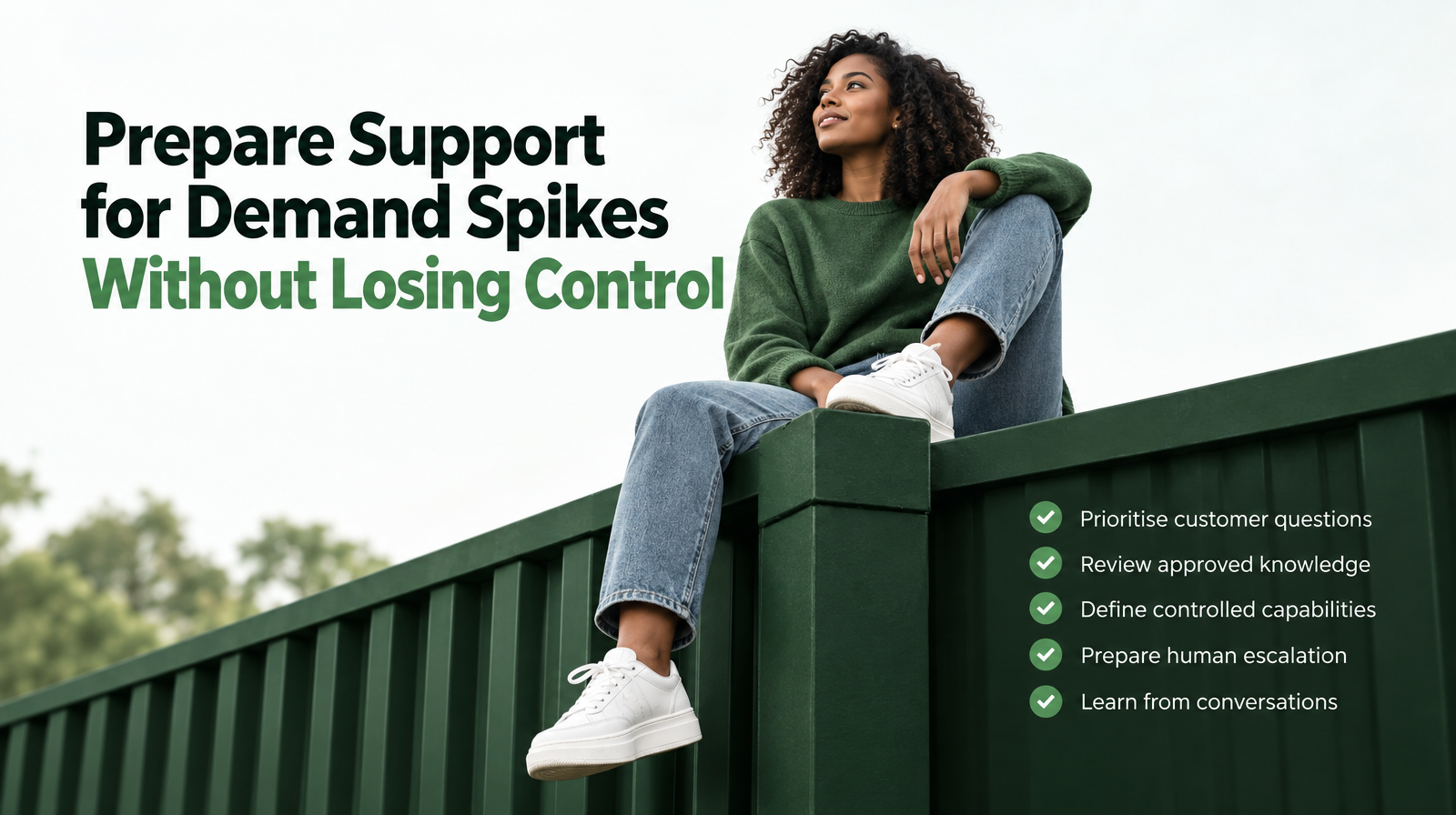
Before you broaden what AI handles, work through this checklist:
- Is your approved knowledge current and complete? The AI can only be as accurate as the materials you have given it. Fill the gaps in your policies and documentation first.
- Are capabilities explicitly defined? Every action the AI can take should be a deliberate grant, with clear thresholds for what requires a human.
- Are escalation triggers specific? Define the situations — emotional distress, account exceptions, consequential decisions — that always route to a person.
- Do escalations preserve context? Your team should receive the conversation history, not just a notification.
- Is there a review rhythm? Sample conversations regularly to confirm answers remain accurate and boundaries are holding, especially after policy changes.
- Does the customer experience stay honest? Customers should get fast help on routine matters and a real person on the ones that count, without friction in either direction.
The Bottom Line
A small business needs AI customer support when demand has durably outgrown the team's hours — when overnight questions pile up, routine volume crowds out substantive work, and consistency starts to slip. The need is real, but the answer is not simply "add AI." It is adding AI with the right controls: answers grounded in approved knowledge, actions limited to capabilities you define, and escalation to a human whenever context matters.
That is the model behind Coffey — AI customer support that never sleeps, built for small businesses and lean teams that field customer questions around the clock. It gives a lean team always-on coverage across every time zone while keeping the business in control of what automation answers, what it does, and when it steps aside.
Once you have recognized the threshold, the next steps are choosing a system and setting it up well. Continue with How to Choose AI Customer Support for Your Small Business, How to Set Up AI Customer Support Boundaries Before You Go Live, and The First 30 Days With AI Customer Support: A Small Business Plan.