
Every small business knows the feeling. You close the laptop at the end of a long day, and somewhere out there a customer is typing a question. Maybe they want to confirm something before they buy. Maybe something isn't working and they're quietly deciding whether to stay or move on. By the time you reply the next morning, the moment has often passed.
For lean teams, after-hours messages aren't an edge case. They're a steady, quiet drain on trust and revenue that rarely shows up cleanly on any dashboard. This article looks at what those missed hours actually cost, why "just hire more people" isn't realistic for most small teams, and how always-on support can close the gap without pretending to replace the humans who make your business what it is.
The Gap Nobody Staffs For
Customer questions don't respect office hours. They arrive during dinner, over the weekend, and in the middle of the night, because the person asking is often wide awake on the other side of the world.
A large company absorbs this with shifts, overnight teams, and follow-the-sun rotations. A three-person startup or a solo operator cannot. So the message sits in an inbox, unread, until someone surfaces the next working morning. The customer, meanwhile, has already formed an impression.
That impression is the real cost. Not a line item, but a slow erosion:
- Lost sales that never announced themselves. A pre-purchase question left unanswered overnight is often a purchase that quietly went somewhere else. You rarely see the order you didn't get.
- Trust that leaks before it's earned. New customers judge responsiveness fast. Silence during their decision window reads as indifference, even when you're simply asleep.
- Support that snowballs. A small question at 11pm can become an angry follow-up, a chargeback, or a public review by the time you reply at 9am.
- Founder attention taxed at the worst hours. The alternative, answering messages yourself late at night, protects the customer but burns out the person the whole business depends on.
None of this is dramatic in the moment. That's exactly why it's dangerous. The cost is invisible, recurring, and easy to normalize.
Why Small Teams Can't Just Staff Overnight
The obvious fix, "hire someone for nights and weekends," collapses under the math and reality of a small operation.
- Coverage is expensive and lumpy. True 24/7 human coverage isn't one hire. Accounting for shifts, weekends, holidays, and sick days, it's several. That's an enterprise cost structure bolted onto a small-team budget.
- Overnight volume is unpredictable. You might get five messages one night and forty the next. Paying a person to wait for sporadic messages is hard to justify, but leaving those messages unanswered is also costly. There's no clean staffing answer.
- Global customers stretch the clock further. If your customers span multiple timezones, there is no "quiet period" to protect. Someone is always in their business day.
- Knowledge is concentrated. In a lean team, the people who actually know the answers are the founders and leads, the exact people who need to sleep.
So most small teams settle for a compromise they never explicitly chose: business-hours support, and hope the after-hours gap doesn't cost too much. The problem is that it does, just quietly.
Always-On Coverage Without Adding Headcount
This is where controlled, always-on AI support earns its place, not as a gimmick, and not as a replacement for your team, but as a dependable first layer that's awake when you can't be.
The goal isn't to automate your customers away. It's to make sure that no genuine question sits in the dark for eight or twelve hours. A well-designed assistant can acknowledge the customer instantly, answer what it confidently knows, take safe actions where you've allowed it, and hand off cleanly to a human when the situation calls for one.
That's the model Coffey is built around: AI customer support that never sleeps, designed specifically for small businesses and lean teams that field questions around the clock but lack the staff for 24/7 human coverage. The emphasis is deliberately on control and trust, not on hype.
Answers grounded in your approved knowledge
The fastest way to lose trust with automation is a confident wrong answer. An after-hours assistant that invents policies or guesses at details creates more cleanup than it saves.
The safer approach is to ground responses in knowledge you've explicitly approved, your documented policies, product details, and support content, rather than letting the system freewheel. That's the principle behind Coffey's "answers you can trust" approach: responses drawn from your approved material, so what a customer hears at 2am matches what they'd hear from you at 2pm.
Practically, this means the quality of your after-hours coverage depends on the quality of what you feed it. Which leads to a useful discipline for any small team.
A Checklist for Trustworthy After-Hours Coverage
If you're setting up always-on support, use this as a working checklist to keep it accurate, on-brand, and safe:
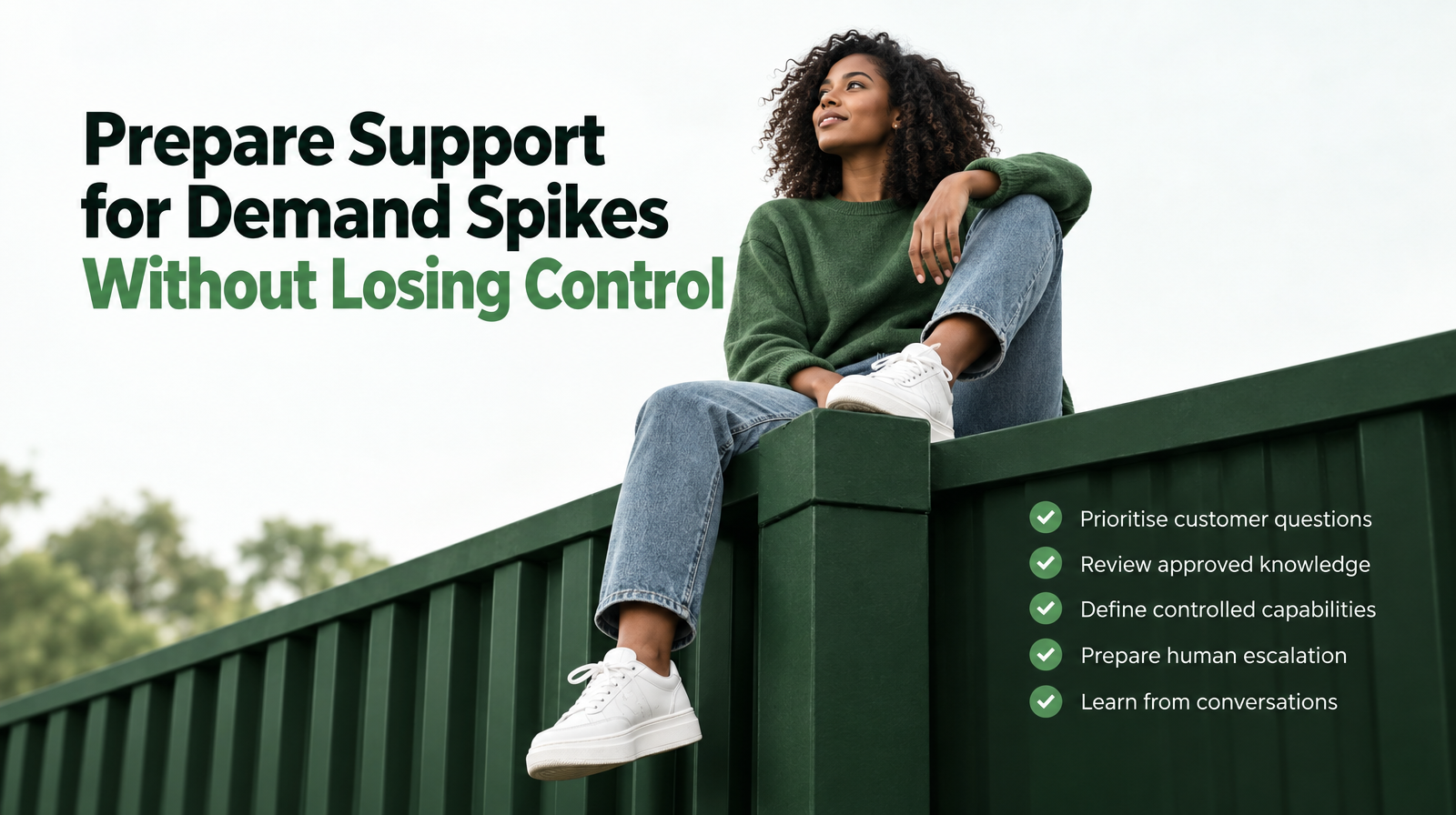
- Document your real answers first. Capture your most common questions and your actual, current answers. Approved, accurate source material is the foundation of every trustworthy automated reply.
- Define what the assistant is allowed to say. Be explicit about topics it should handle confidently versus topics it should never improvise on, such as edge-case refunds, legal questions, or anything involving a customer's specific account risk.
- Set clear permissions for any actions. If the assistant can act on live data, decide precisely what it may and may not do. Control isn't a nice-to-have here; it's the whole point.
- Write your escalation rules deliberately. Decide, in advance, which situations should stop the automation and reach a human.
- Review the handoffs regularly. Read what got escalated and why. It tells you where your approved knowledge has gaps and where customers keep getting stuck.
- Keep your source material current. When a policy or product changes, update the knowledge the same day. Stale answers erode trust as fast as wrong ones.
Knowing When a Human Should Step In
The most important design decision in after-hours support isn't what the AI answers. It's what it doesn't.
Some messages should never be resolved by automation alone. A frustrated customer signalling they might leave. A sensitive account or billing dispute. Anything ambiguous, high-stakes, or emotionally charged. In those moments, the right move is a clean escalation to a person, ideally with the context already gathered so your team isn't starting cold.
This is what turns automation from a risk into a genuine asset. Handled well, escalation becomes a trust mechanism, not a failure: the customer feels heard immediately, and the hard conversations still reach a human who can actually own them. Coffey's model reflects this directly, escalating to your team when a human is needed, rather than pretending it can carry every conversation on its own.
The reassurance runs both ways. Your customers get an instant, competent response instead of silence. Your team gets to sleep, and wakes up to a tidy queue of the conversations that actually needed them, not a backlog of "did anyone reply to this?"
Reframing the Real Cost
The question for a small team was never "should we run a full overnight support desk?" That was always out of reach, and pretending otherwise just leads to burnout or guilt.
The real question is quieter and more honest: what is the current after-hours gap costing you, and is that an acceptable price? Every unanswered overnight message is a small wager that the customer will wait patiently until morning. Sometimes they do. Often, especially with a purchase decision or a first impression on the line, they don't.
Always-on, controlled AI support changes the terms of that wager. Not by replacing the people who make your business worth choosing, but by making sure the lights stay on while they rest, that questions are met with grounded answers, and that the moments truly needing a human still reach one