
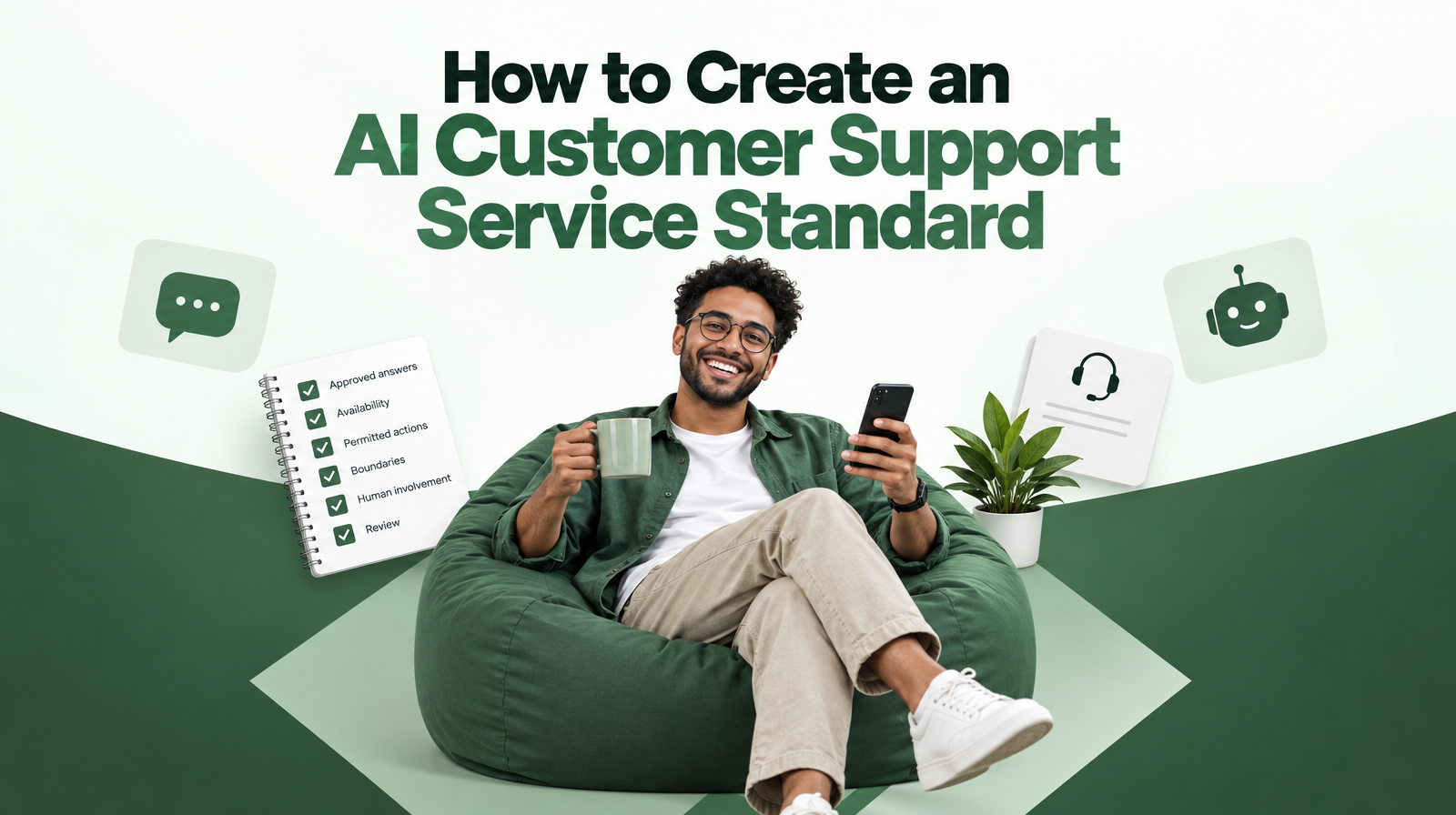
An AI customer support service standard defines what customers should expect from automated support before the system handles real conversations. For a small business or lean team, it should cover six decisions: what the AI may answer, when support is available, what it may do, where its boundaries are, when a human becomes involved, and who reviews the standard.
The purpose is not to make every conversation identical. It is to make the experience dependable, controlled and understandable.
What is an AI customer support service standard?
An AI customer support service standard is a practical set of expectations for customer conversations supported by AI.
It explains:
- Which customer questions the assistant should handle
- Which business-approved information may guide its answers
- What actions or capabilities the assistant may use
- What it must not answer, decide or do
- When a human should review or take over
- How the business maintains and reviews the standard
A service standard is broader than a script. A script provides wording for a particular situation. A standard defines what makes an answer appropriate across many different versions of that situation.
It is also different from a governance document or capability checklist. Governance explains responsibility and oversight in greater depth. A capability checklist records what the system can do. The service standard connects those decisions to the customer experience.
Why define the standard before using AI support?
Small teams often carry support knowledge informally. One person knows the usual answers, another handles operational questions, and a founder steps in when a conversation becomes sensitive or complicated.
That approach can become difficult to maintain when:
- Questions arrive outside normal working hours
- Customers are spread across time zones
- Several team members answer differently
- Routine questions interrupt higher-value work
- The business begins using AI for additional coverage
- No one is sure which conversations require human judgement
Without a shared standard, an AI assistant may be technically capable of responding without having a clearly defined role. It may also be unclear whether an answer is approved, whether an action is permitted or whether the customer should be directed to a person.
Defining the standard first gives the team a reference point. Instead of asking only, “Can the AI answer this?”, the business can ask:
“What should a good response look like here, and who remains responsible for the outcome?”
That question keeps automation connected to the business’s actual service expectations.
Build the standard around six decisions
A useful standard can be concise. Start with the following six areas.
1. Define the questions the AI should answer
Begin with the customer questions the business already understands well.
These may include routine requests about services, processes, policies or other information that the business has deliberately approved for customer use. The aim is not to make the assistant answer every possible question. It is to establish a reliable scope.
For each question category, record:
- What the customer is usually trying to learn
- Which information is approved for the answer
- What a useful response should help the customer do next
- What uncertainty or exceptions require human involvement
A good answer should be:
- Based on approved business knowledge
- Directly relevant to the customer’s question
- Clear enough to understand without internal context
- Honest when the available information is incomplete
- Consistent with the business’s current position
The business should also define what happens when the approved information does not provide an answer. The standard should favour clarity over improvisation. If the assistant cannot answer confidently within the approved scope, it should make that limitation clear and identify the appropriate human path.
2. Define what “available” means
For an AI customer support service, availability is more than a claim that the assistant can operate around the clock.
A useful standard explains what customers can expect when the human team is unavailable. For example:
- Routine questions may receive support outside team working hours
- Requests requiring judgement may be identified for the team
- The assistant should not imply that a human is immediately available when one is not
- Customers should understand when their request needs further attention
- The team should know which conversations require review
This distinction matters for small businesses. Always-on support can provide a dependable first layer of assistance across time zones, but it does not mean that every request should be resolved automatically.
Coffey is an AI customer support assistant that never sleeps. Its role is to help small businesses and lean teams keep support available beyond the hours their staff can cover, while the business defines the knowledge, capabilities and human involvement behind that experience.
3. Separate answers from actions
Answering a question and taking an action are different service decisions.
An answer gives information. An action may change something, retrieve live information or affect part of the customer experience. Because actions can carry different operational consequences, they should be defined separately.
Your standard should state:
- What the assistant may explain
- Which capabilities it may use
- What conditions apply before an action is taken
- Which actions are outside its scope
- Which actions require human review
This prevents a common planning error: treating every technically possible capability as automatically appropriate for customer support.
The business remains responsible for deciding what the assistant is permitted to do. Controlled capabilities allow a small team to extend useful support without giving automation unrestricted authority.
Coffey acts through capabilities the business controls. That makes the business’s decisions about permissions part of the customer-facing service standard, not merely a technical configuration choice.
4. Write explicit boundaries
Boundaries should be specific enough to guide a real conversation.
Avoid vague instructions such as:
- “Use good judgement.”
- “Handle anything straightforward.”
- “Help the customer as much as possible.”
These may express a goal, but they do not tell the team or assistant what to do when a situation is unclear.
Instead, write practical rules such as:
- Use only information the business has approved for customer-facing support.
- Do not guess when the available information is incomplete.
- Do not promise an outcome the business has not defined.
- Take action only through capabilities the business has permitted.
- Do not make decisions that require human judgement.
- Involve a person when the request falls outside the defined scope.
The boundary should also cover requests that begin as routine but become more complex. A customer may ask a simple question and then introduce an exception, dispute or unusual circumstance. The service standard should make clear that the assistant’s role can change as the conversation changes.
5. Define when a human becomes involved
Human escalation should be designed before it is needed.
A person may need to become involved when:
- The customer’s situation requires judgement
- The available knowledge does not resolve the issue
- The request is sensitive, unusual or complex
- The customer asks to speak with someone
- The requested action is not permitted
- A mistake could have significant consequences for the customer or business
This does not mean sending every conversation to a human. If routine questions are routinely escalated, the business loses much of the benefit of an always-on support layer.
The objective is a clear boundary: the AI handles what the business has approved, while the team remains responsible for situations that require context, discretion or a decision.
Coffey supports this model by escalating to a human when needed. It is positioned as a support layer for the team, not a replacement for the team.
6. Assign review responsibility
A standard needs an owner.
The business should decide who is responsible for checking that:
- Approved information remains current
- Permitted capabilities still match business needs
- Human escalation rules remain clear
- New types of customer questions are considered
- Changes to services or policies are reflected in support expectations
For a small team, this does not need to become a large administrative process. One person may coordinate the review, while subject-matter owners confirm particular information or capabilities.
The important point is that “the AI will handle it” is not an ownership model. The business remains responsible for defining the service and maintaining the boundaries around it.
Use plain language customers and staff can apply
A service standard is strongest when it can be understood quickly by everyone who relies on it.
Prefer:
“The assistant answers from approved business knowledge and says when that information is insufficient.”
Over:
“The assistant should provide accurate, context-aware responses.”
Prefer:
“The assistant may use only the capabilities the business has defined.”
Over:
“The assistant can take appropriate actions.”
Plain language reduces interpretation. It also makes review easier because the team can test whether a conversation followed a clear rule.
The standard does not need to contain every possible example. It should provide principles that can be applied consistently, supported by a small set of representative scenarios.
Test the standard with real situations
Before relying on the standard, walk through examples from different categories:
- A routine question with a clear approved answer
- A question where the approved information is incomplete
- A request that asks for an action
- A question that changes from routine to unusual
- A customer request for human assistance
- A question received when the team is unavailable
For each scenario, ask:
- What should the assistant say?
- Which approved information supports the response?
- Is the assistant answering or taking an action?
- Is that action permitted?
- What should happen if the customer continues?
- Does a human need to become involved?
- Who reviews the conversation if the standard was unclear?
These tests expose gaps before they become customer-facing problems.
A scenario should not pass merely because the assistant produces fluent wording. It should pass when the expected answer, permitted role and human boundary are all clear.
A reusable AI support service standard template
Small businesses can start with this one-page structure.
Customer experience
What should customers consistently be able to expect from AI-supported service?
Approved answers
Which questions may the assistant answer, and which business information may guide those answers?
Availability
What support is available outside normal team hours, and what should customers understand about human involvement?
Permitted actions
What may the assistant do, retrieve or initiate through business-controlled capabilities?
Boundaries
What must the assistant not answer, decide, promise or do?
Human involvement
Which situations require review, escalation or direct human support?
Ownership and review
Who maintains the standard, and when is it reviewed after changes to the business, knowledge or capabilities?
Keep the standard current
A service standard can become unreliable when the business changes but the document does not.
Review it when:
- Services or policies change
- Approved customer information is updated
- A new capability is introduced
- The team’s responsibilities change
- Customers begin asking a new type of question
- A conversation reveals an unclear boundary
The review should focus on decisions, not paperwork. Record what changed, what the assistant may now answer or do, and where human involvement remains necessary.
Final takeaway
An AI customer support service standard turns automation into a defined service rather than an undefined source of replies.
For a small business or lean team, the essential decisions are straightforward: identify approved answers, define availability, separate information from action, set boundaries, establish human involvement and assign review responsibility.
Coffey helps small businesses keep customer support available with an AI assistant that never sleeps. It answers using approved knowledge, acts through capabilities the business controls and escalates to a human when needed. The business remains responsible for deciding what dependable support means.
That is the foundation of controlled, trustworthy automation: support can remain available without leaving service expectations, permissions or human judgement undefined.