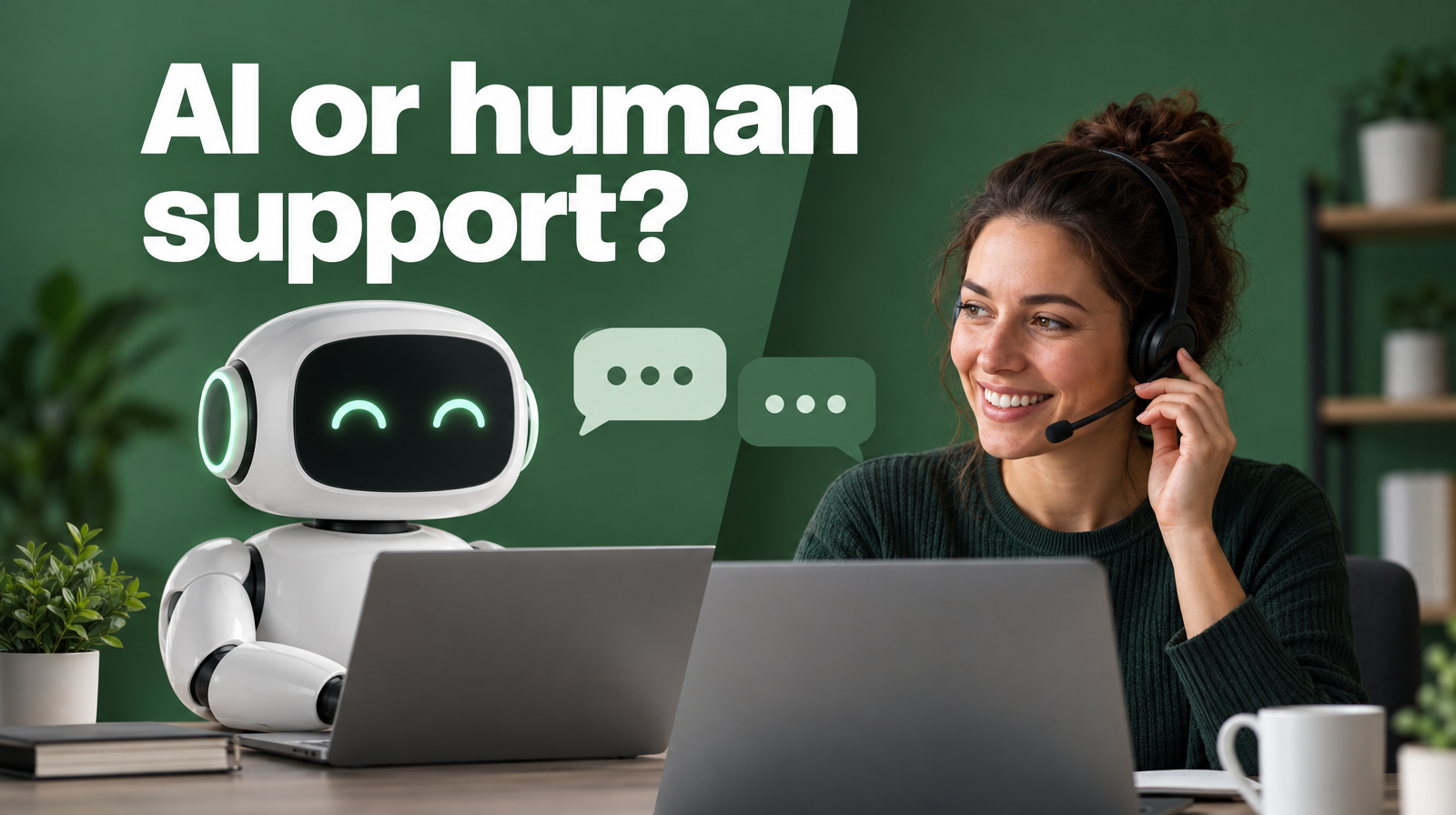
For small businesses and lean teams, the choice between AI customer support and 24/7 human support is not simply a choice between automation and people. It is a decision about availability, responsibility, knowledge, permitted actions and escalation.
AI customer support is often the better fit when a business needs dependable coverage for routine questions across the clock but cannot staff continuous human support. A 24/7 human team may be more appropriate when every interaction requires judgement, complex problem-solving or immediate personal involvement. In many cases, the most practical model combines the two: AI provides an always-available first layer, while people remain responsible for unusual, sensitive or consequential situations.
The right question is not, “Can AI replace a 24/7 support team?” It is:
Which parts of customer support need to be available at all times, and which parts need human responsibility?
The difference between AI customer support and 24/7 human support
The two models differ most clearly in how they provide availability and handle responsibility.
24/7 human support means people are available continuously to read, interpret and respond to customer questions. This can offer direct judgement and personal attention, but it requires an operating model that keeps human coverage available across all relevant hours and time zones.
AI customer support provides an automated support layer that can remain available when the team is offline. It can answer questions using approved business knowledge and, where the business enables it, act through defined capabilities. When a conversation needs human judgement, the AI-supported model should provide a clear route to a person.
That means AI availability does not equal unrestricted automation. An assistant being available at 2 a.m. does not mean it should answer every question, make every decision or take every possible action.
For a lean team, this distinction is central. AI can extend availability, but the business still decides:
- what information the assistant may use;
- which customer questions are suitable for automated support;
- what capabilities it may access;
- which situations require escalation;
- who remains responsible for the customer experience.
AI customer support vs 24/7 human support: decision matrix
Use the following matrix to compare the models against the operational questions that matter most.
| Criterion | AI customer support | 24/7 human support |
|---|---|---|
| Availability | Can provide a support layer outside normal team hours and across time zones | Requires people to be scheduled and available continuously |
| Routine questions | Suitable when answers are supported by approved knowledge | Suitable, although human attention may be used for repeatable requests |
| Knowledge control | Depends on the approved information provided and maintained by the business | Relies on training, documentation and the judgement of individual team members |
| Permitted actions | Can act through business-controlled capabilities where available | People may have broader discretion, depending on internal permissions |
| Unusual questions | Should recognise limits and escalate rather than guess | A person can interpret context and decide how to proceed |
| Sensitive situations | Should have a defined stopping point and human path | Human handling may be appropriate from the outset |
| Escalation | Requires a clear process for involving the team | The interaction is already with a human |
| Operational responsibility | Remains with the business that defines knowledge, capabilities and handoff rules | Remains with the business and its support operation |
| Maintenance | Approved knowledge and capability boundaries need ongoing review | Training, staffing, documentation and quality management need ongoing review |
| Best fit | Lean teams needing dependable coverage for appropriate questions | Businesses where continuous human judgement is essential |
The matrix highlights an important buying principle: availability and responsibility are separate decisions. A system can be available continuously without being authorised to handle every type of customer need.
When AI customer support is a better fit for a small business
AI customer support is often a strong fit when a small business has a clear gap between customer availability and team availability.
That may be the case when:
- customers ask routine questions outside working hours;
- enquiries arrive from different time zones;
- the same questions consume a disproportionate amount of the team’s attention;
- the business wants customers to receive an initial response while the team is unavailable;
- the team needs to reserve human attention for situations that require judgement;
- the business can define approved knowledge and controlled capabilities.
The fit is strongest when the business is prepared to manage the assistant as part of its support operation, rather than treating it as a hands-off replacement for the team.
For example, a lean team might decide that an AI assistant can explain approved service information, answer established policy questions and support a defined action using live business data. A question that falls outside those boundaries can be directed to a person instead.
This approach gives the team a practical way to expand coverage without claiming that every customer conversation should be automated.
Which customer questions are suitable for AI support?
The best starting point is not the question that sounds most impressive in a product demonstration. It is the question that is:
- common enough to matter;
- clear enough to interpret;
- supported by approved business information;
- low enough in ambiguity for the business to define a safe response;
- unlikely to require personal judgement at the first step.
Suitable categories may include routine questions about information the business has approved for customer-facing use. They may also include narrowly defined requests where the assistant can use a capability that the business has deliberately made available.
Before assigning a question to AI support, ask:
- Is the expected answer documented?
- Would different reasonable interpretations lead to different outcomes?
- Does the answer depend on current or customer-specific data?
- Is a permitted action required?
- What should happen if the information is missing or unclear?
- Does the customer need a person to understand the situation properly?
If the answer is not supported by approved knowledge, the assistant should not fill the gap with a confident guess. If an action is required, the business should define what the assistant may do and where it must stop.
What should remain with a human support team?
Human support should remain responsible for situations where context, discretion or accountability matters more than simple availability.
Examples can include:
- unusual or ambiguous requests;
- sensitive customer situations;
- complaints that require careful interpretation;
- cases where approved knowledge does not provide a clear answer;
- requests that exceed the assistant’s permitted capabilities;
- situations where the customer specifically needs human involvement;
- decisions that the business has chosen not to delegate.
The exact boundary depends on the business. A support lead should document it before launch rather than relying on the assistant to discover the boundary through trial and error.
Human escalation also needs an operational owner. “Escalate to a human” is not a complete process unless the business knows who reviews the case, what context they receive and what the customer should expect next.
Coffey is positioned around this balance: it is an AI customer support assistant that never sleeps, answers using approved knowledge, acts through capabilities the business controls and escalates to a human when needed. That makes it relevant to small businesses and lean teams looking for an always-on support layer without presenting AI as a replacement for human responsibility.
Why approved knowledge changes the comparison
Knowledge control is one of the most important differences between a well-designed AI support model and an unrestricted automation approach.
With AI customer support, the business must decide which information is authoritative for customer-facing answers. That may include approved material about its services, policies, processes and common questions. The team also needs a way to review that information as the business changes.
Human teams need reliable knowledge too, but people may compensate for gaps through experience, questions to colleagues or judgement in the moment. An AI assistant should have a clearer boundary: if the approved information does not support an answer, it should not invent one.
This is why “AI support” is not a single operating model. One assistant may be connected to carefully maintained business knowledge and defined capabilities. Another may have unclear sources and no practical stopping point. Those systems should not be treated as equivalent.
When assessing a provider, ask to see how the business controls:
- the information used for answers;
- updates to that information;
- the capabilities available to the assistant;
- the conditions for human escalation;
- review of conversations that fall outside expectations.
Can AI customer support act on live data?
It can, where the support system provides a capability for that purpose and the business controls how it is used. But the existence of a live-data capability does not make every action appropriate.
Separate three questions:
What data is needed?
A request may require information that changes over time or is specific to the customer. The business should understand what information the capability uses and whether that information is appropriate for the task.
What action is permitted?
The business should define the action narrowly. “Help customers” is too broad to govern. A specific, clearly described capability is easier to review than open-ended authority.
When must the assistant stop?
An action should have a boundary for ambiguity, missing information, unusual circumstances or customer requests outside its intended scope.
Coffey’s verified positioning is that it can act on live data through capabilities the business controls. That should be understood as controlled assistance, not unrestricted access or independent authority.
What responsibilities remain with the business?
Choosing AI customer support does not transfer responsibility away from the business. The business still needs to own the support design.
That includes:
- deciding which customer needs are suitable for AI;
- approving the knowledge used for answers;
- defining available capabilities and permissions;
- maintaining information as services and policies change;
- setting escalation conditions;
- ensuring someone can handle escalated conversations;
- reviewing representative interactions;
- explaining the support experience clearly to customers;
- deciding when a human must take over.
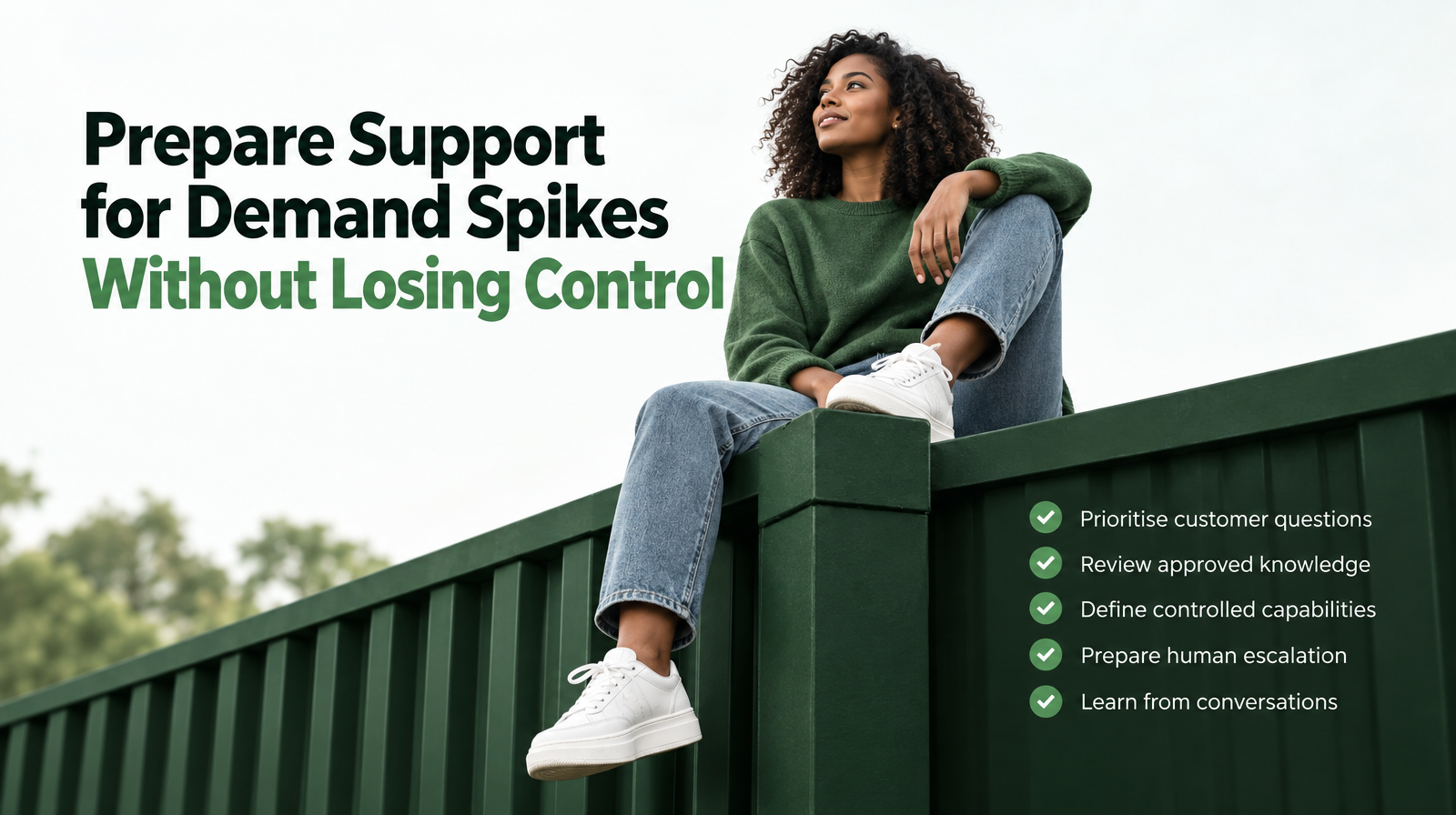
A useful operating rule is to review support in three lanes:
- Answer: What can the assistant explain from approved knowledge?
- Act: What can it do through a capability the business has defined?
- Escalate: What requires human judgement or responsibility?
This framework helps avoid the common mistake of evaluating AI support only by whether it is available. Coverage matters, but controlled coverage is more useful than availability without clear limits.
How to choose between the two models
Choose 24/7 human support when:
- customers consistently need judgement from the first interaction;
- situations are highly varied or sensitive;
- the business has a clear operational need for continuous personal involvement;
- the organisation can responsibly staff and manage that coverage.
Choose AI customer support when:
- many questions are routine and supported by approved knowledge;
- customers need assistance outside the team’s working hours;
- the business needs coverage across time zones;
- the team can define controlled capabilities;
- human support should focus on exceptions, judgement and accountability.
Choose a combined model when the business needs both dependable availability and human responsibility. For many small businesses, this is the practical middle ground: AI handles suitable first-line support, while people remain available for the conversations that should not be forced through automation.
The best choice for a lean team
For most small businesses, the decision should not be framed as AI versus people. It should be framed as AI-supported availability versus continuous human staffing, with the business deciding where each model belongs.
A 24/7 human operation offers direct human judgement throughout the customer experience, but it requires continuous staffing and operational ownership. AI customer support can help a lean team remain available beyond its working hours, provided the assistant uses approved knowledge, works only through controlled capabilities and escalates when human involvement is needed.
Coffey is built for that model: an always-on AI customer support assistant for small businesses and lean teams that want dependable automation they can control and trust.
The strongest choice is the one that matches customer needs to the right kind of responsibility. Use AI where availability and repeatability matter. Keep people involved where context, discretion and judgement matter. That is how a small team can extend support coverage without giving up control of the customer experience.