
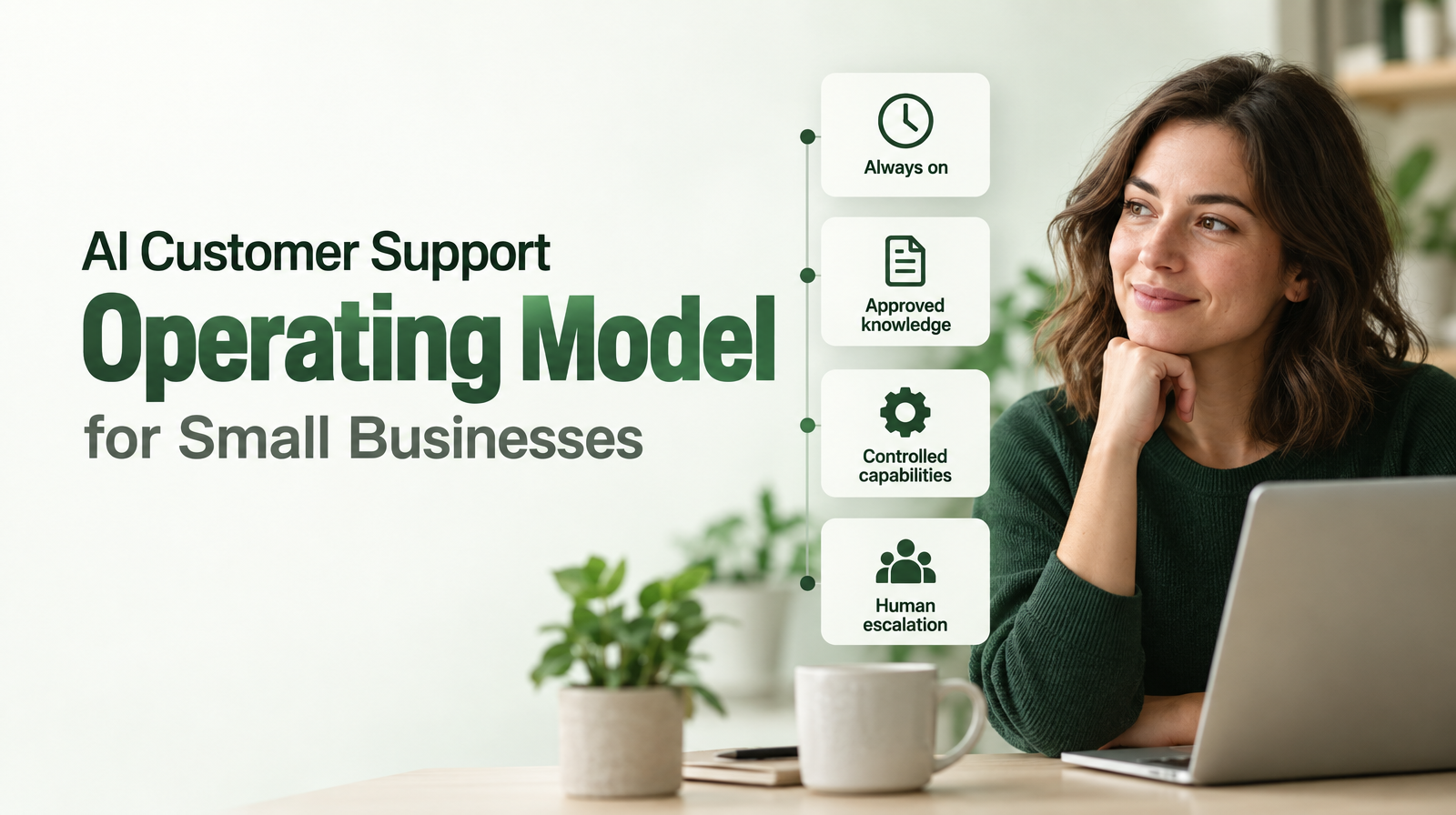
An effective AI customer support operating model for small businesses treats AI as a controlled support layer, not a replacement for the team. The model separates four decisions: when support should be available, what knowledge the assistant may use, which capabilities it may access, and when human judgement must take over.
That structure helps founders, operators, and support leads extend coverage across time zones and beyond staff hours while keeping responsibility clear.
What is an AI customer support operating model?
An AI customer support operating model is the practical design for how an AI assistant participates in customer service.
It defines:
- Availability: when customers can receive assistance
- Knowledge: which information may guide answers
- Capabilities: what the assistant is authorised to do
- Human escalation: when a person must become involved
- Business ownership: who remains responsible for the support experience
This is broader than choosing a chatbot or adding an automated reply box. It is a way to decide how AI and people should work together in real customer conversations.
For a small business, the distinction is important. Customer questions may arrive at any hour, but the team may not have continuous human coverage. An AI assistant can remain available during those gaps, provided its role is defined carefully.
The objective is not to automate every conversation. It is to make appropriate support available more often without giving an automated system authority the business has not deliberately assigned.
The four parts of a controlled AI support model
A useful operating model can be built around four connected layers.
1. Availability: decide when support should be present
Small teams often face a timing problem rather than a volume problem. A customer may ask a routine question while the team is working elsewhere, outside normal hours, or in another time zone.
An always-on customer support layer can help in those moments. It can provide assistance when a member of the team is not immediately available, giving customers a way to make progress without implying that every issue will be resolved automatically.
Availability should therefore be defined in terms of access to appropriate assistance, not unlimited resolution.
A sensible availability policy answers questions such as:
- Is the assistant available outside staff hours?
- Can customers ask questions across different time zones?
- Which types of requests can receive an immediate answer?
- What should customers expect if their situation needs a person?
- How will the business make the human boundary clear?
The phrase “support that never sleeps” is most useful when it describes continued availability within a defined role. It should not suggest that the assistant has unrestricted authority or that human support is no longer necessary.
2. Approved knowledge: define what may guide answers
An AI support assistant is only as dependable as the information the business has chosen to make available for support.
Approved knowledge gives the business a clear source of authority. Instead of expecting the assistant to answer from an undefined collection of information, the team decides which business knowledge should guide customer conversations.
That might include information the business has specifically prepared and approved for support. The exact content will differ between companies, but the operating principle remains the same: the business decides what represents its current position.
A practical knowledge check includes:
- Is this information accurate?
- Is it current?
- Does it reflect how the business actually serves customers?
- Is it written clearly enough to support consistent answers?
- Is it appropriate for customer-facing use?
- Who owns updates when the business changes?
This is not merely a content task. It is an operating responsibility. If information changes, the business should know which support answers may be affected and who is responsible for keeping the approved source current.
Coffey is designed to answer using a business’s approved knowledge. That allows a small business to remain the author of the information behind its automated support while Coffey provides the always-on assistance layer.
3. Controlled capabilities: define what the assistant may do
Some customer requests require more than an explanation. They may require an action through live business data or another capability that the business has deliberately made available.
This is where controlled AI support differs from open-ended automation. The question is not simply whether the assistant could perform an action. The question is whether the business has decided that the action belongs inside the assistant’s role.
Separate capabilities into three groups:
Information answers
These are requests the assistant can address using approved knowledge. The business should be able to explain why the relevant information is suitable for customer-facing use.
Business-controlled actions
These are actions the assistant may perform through capabilities the business defines and controls. They should exist for a clear support purpose and remain within the authority the business has chosen to provide.
Human-owned work
These are actions or decisions that should remain with the team because they require context, discretion, responsibility, or judgement.
This separation helps prevent a common design error: treating every possible automation as equally appropriate. A small business can gain value from controlled capabilities without making the assistant responsible for every operational decision.
Coffey acts on live data through capabilities the business controls. The important point is the control relationship: the business determines the capabilities available to the support assistant.
When should AI customer support escalate to a human?
Human escalation should be part of the operating model from the beginning, not added only after automation encounters a difficult conversation.
A human should become involved when the assistant cannot provide dependable help within its approved knowledge or controlled capabilities. Escalation may also be appropriate when a conversation requires judgement, discretion, context, or a level of responsibility that the business has reserved for its team.
Useful escalation questions include:
- Is the answer supported by approved knowledge?
- Does the request fall within the assistant’s defined capabilities?
- Is the customer asking for an exception or a decision?
- Does the situation require interpretation rather than information?
- Is the customer’s concern sensitive, unusual, or difficult to resolve through a standard response?
- Would continuing automatically risk creating confusion about who is responsible?
The exact triggers will vary by business. The core principle is consistent: automation should have a clear stopping point.
Coffey escalates to a human when one is needed. This makes human support part of the service design rather than evidence that the AI layer has failed. The assistant handles suitable conversations within scope, while the team remains available for situations that require human judgement.
How small businesses can use AI without replacing their team
The strongest reason to adopt AI customer support is often not to remove people from support. It is to use limited human attention more deliberately.
A lean team may be helping one customer while another asks a routine question. It may be handling a complex conversation while several customers need basic information. It may be unavailable for a period while customers continue to seek help across time zones.
An AI support layer can participate in those moments by:
- Remaining available beyond staff hours
- Answering from approved business knowledge
- Handling suitable routine questions
- Acting only through business-controlled capabilities
- Escalating conversations that require a person
The team still owns the support experience. Its role becomes clearer: define the assistant’s operating boundaries, maintain the approved knowledge, control its capabilities, and provide human judgement where it matters.
That is different from claiming that AI can replace a human support function. A controlled model uses automation to extend availability while preserving a human role for conversations that cannot be responsibly reduced to a standard answer or defined action.
A practical decision framework for support requests
When reviewing a customer question, classify it using three tests.
Test one: Can the assistant answer?
If the answer is directly supported by approved knowledge and does not require an unapproved interpretation, it may belong in the information-answer category.
Test two: Can the assistant act?
If the customer needs an action rather than an explanation, check whether that action is available through a capability the business has deliberately controlled.
Test three: Does the situation need judgement?
If the request involves uncertainty, discretion, an exception, or a conversation that the business wants a person to own, it belongs in the human-escalation category.
This creates a simple operating table:
| Customer need | Appropriate support role |
|---|---|
| A question answered by approved information | AI answer |
| A defined action through a business-controlled capability | Controlled AI action |
| A situation requiring context, discretion, or judgement | Human support |
| A request outside approved knowledge or capabilities | Clarify, limit, or escalate |
The table is not a substitute for business-specific decisions. It is a way to make those decisions visible and consistent.
How to introduce controlled AI customer support
A small business does not need to begin with an abstract automation strategy. It can start with the customer questions already arriving.
Step 1: Review real support conversations
Look for recurring questions, after-hours enquiries, and requests that repeatedly interrupt the team. The purpose is to identify where customers need more availability, not to assume that every question should be automated.
Step 2: Separate information from judgement
For each recurring request, ask whether it needs a known answer, a controlled action, or a person’s judgement. This distinction reveals where an AI layer may help and where it should not be used.
Step 3: Approve the knowledge behind answers
Choose the information the assistant should use and identify who is responsible for keeping it current. Avoid treating setup as a one-time task if the business changes regularly.
Step 4: Define capabilities narrowly
Enable only the capabilities that serve a clear customer-support purpose and remain within business control. More capability is not automatically a better operating model.
Step 5: Establish the human boundary
Decide what should trigger human involvement and make the route to a person clear. The team should know which conversations it owns and customers should not be left to infer whether human help is available.
Step 6: Review the model as an operating practice
After launch, review whether the assistant is answering within approved knowledge, whether its capabilities remain appropriate, and whether human escalation is happening where it should. The model should adapt as the business and its customer questions change.
What to look for when choosing an AI support assistant
When evaluating AI customer support for a small business, look beyond whether a product can generate responses. Assess whether it supports the operating model your team actually needs.
Look for clear answers to these questions:
- Can the assistant remain available beyond staff hours?
- Does it use knowledge the business approves?
- Can the business control what it is allowed to do?
- Does it support actions through defined capabilities rather than unrestricted access?
- Can it escalate to a human when needed?
- Is the product positioned as a support layer rather than a replacement for the team?
- Can the business explain its role clearly to customers and staff?
These criteria matter because availability without control can create uncertainty, while control without useful coverage may not solve the original support problem.
For founders, operators, and support leads, the best fit is usually the assistant whose boundaries are easiest to understand and manage in daily work.
Where Coffey fits
Coffey is an AI customer support assistant that never sleeps, built for small businesses and lean teams that receive customer questions around the clock but do not have continuous human coverage.
Its role aligns with the operating model described here:
- It provides an always-on support layer
- It answers using the business’s approved knowledge
- It acts on live data through capabilities the business controls
- It escalates to a human when needed
Coffey does not need to replace a support team to be useful. Its value is in extending availability while keeping knowledge, capabilities, and human judgement under business control.
Conclusion
An AI customer support operating model is a plan for dividing responsibility, not a promise to automate everything.
Small businesses can use AI customer support effectively by separating:
- Availability: when customers can receive assistance
- Approved knowledge: what should guide the assistant’s answers
- Controlled capabilities: what the assistant is authorised to do
- Human judgement: when a person must become involved
This structure lets lean teams provide support beyond staff hours and across time zones without presenting continuous automation as a substitute for human responsibility.
For businesses looking for a controlled support layer, Coffey brings these principles together: support that never sleeps, answers grounded in approved knowledge, capabilities the business controls, and human escalation when it matters.