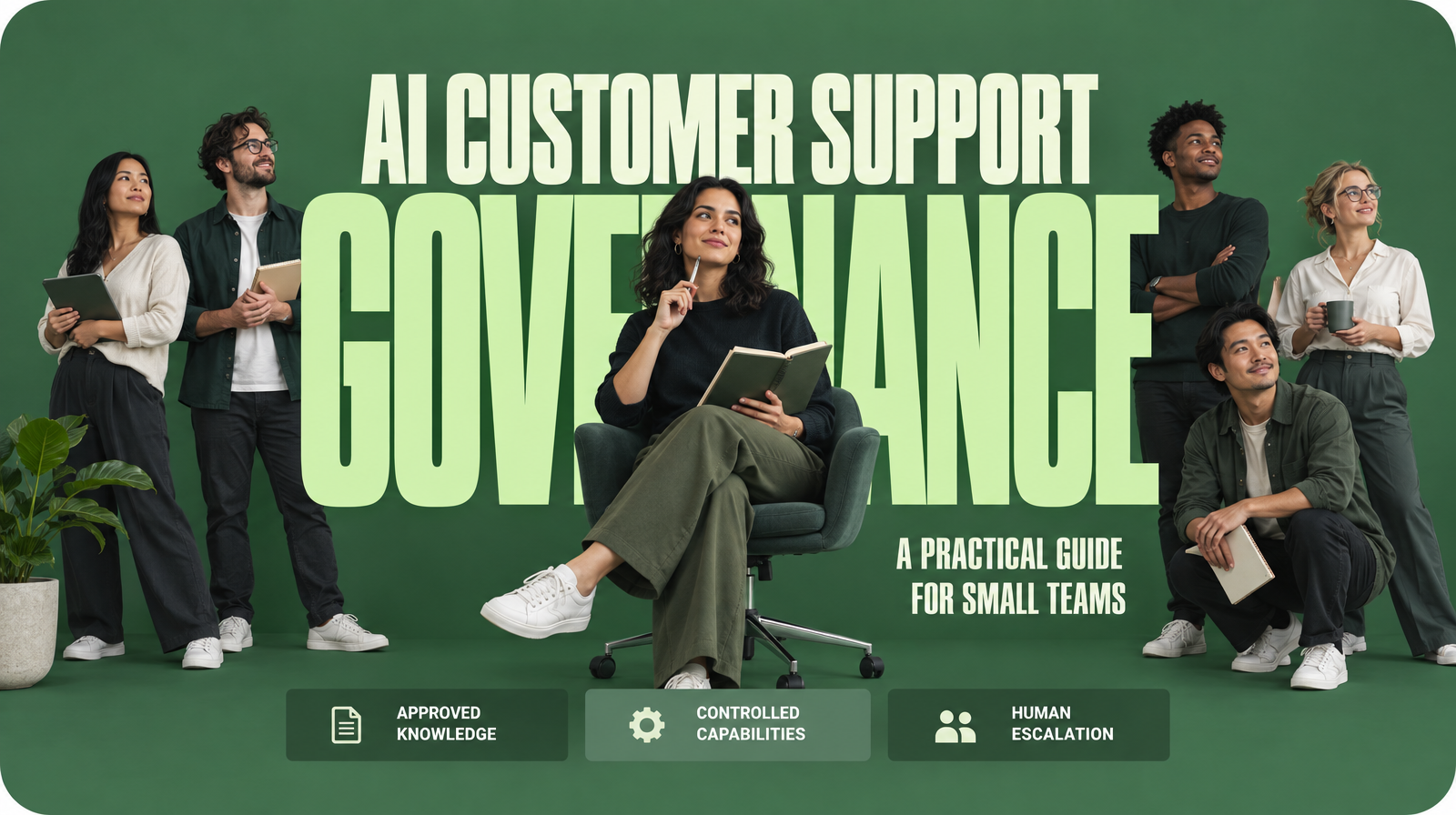
AI customer support governance is the operating framework that defines what an AI assistant may know, do and decide, who remains responsible for it, and when a human should take over. For small businesses and lean teams, the goal is not to remove human responsibility. It is to extend customer support coverage while keeping knowledge, capabilities, permissions and escalation under deliberate business control.
A useful governance framework answers five questions:
- Who owns the AI support experience?
- What information is approved for customer-facing answers?
- What is the assistant allowed to do beyond answering?
- When must a conversation escalate to a human?
- How will the team review and improve the system?
These decisions matter whenever customer questions arrive outside the hours a small team can cover. They are especially important for businesses serving customers across time zones, where support needs may continue while the team is offline.
What is AI customer support governance?
AI customer support governance is the collection of rules, responsibilities and review routines that shape how an AI customer support assistant operates.
It includes more than configuring an assistant or providing it with information. Governance establishes the boundaries around the entire support model:
- The assistant’s intended role
- The information it may use
- The actions it may take
- The situations it should not handle alone
- The people responsible for maintaining and reviewing it
This distinction is important. An AI assistant may be capable of producing an answer, but capability does not automatically mean permission. Similarly, a customer may ask a routine question, but that does not mean every related business action should be automated.
Good governance makes those differences explicit.
Why governance matters for small businesses
Small teams often consider AI customer support because customer questions keep arriving when staff are unavailable. The attraction is straightforward: an always-on support layer can help customers begin a conversation even when the business cannot provide continuous human coverage.
But availability without boundaries can create uncertainty. If no one has decided what the assistant may say or do, the business may be relying on informal assumptions rather than a clear operating model.
Without governance:
- Team members may disagree about the assistant’s responsibilities.
- Outdated or unapproved information may remain available to customers.
- Answers may be mistaken for permission to take action.
- Complex conversations may continue without timely human involvement.
- The business may react to individual errors without fixing the underlying rule.
For a lean team, governance does not need to be a large documentation project. It can begin with a concise operating record that identifies the owner, approved knowledge, controlled capabilities, escalation expectations and review routine.
1. Assign one accountable owner
The first governance decision is ownership.
A founder, operator or support lead may own the AI customer support assistant alongside other responsibilities. What matters is that the role is named clearly. “The team” is not specific enough when a decision needs to be made about knowledge, capabilities or escalation.
The owner should be responsible for coordinating decisions such as:
- Which customer questions the assistant is meant to support
- Which information is approved for use
- Who can update that information
- Which capabilities are enabled
- What requires human judgement
- How recurring issues are reviewed
A small team can divide these responsibilities between several people, but each area should still have a clear owner. For example:
| Governance area | Practical responsibility |
|---|---|
| Support scope | Decide which customer needs the assistant is intended to cover |
| Approved knowledge | Maintain the information used for customer-facing answers |
| Capabilities | Define what the assistant may do with live data |
| Escalation | Set the conditions for human involvement |
| Review | Examine recurring gaps, unclear answers and policy changes |
Ownership also means deciding who can approve a change. If anyone can alter the information or capabilities without review, the governance model is incomplete.
2. Define approved knowledge
Approved knowledge is the information a business has deliberately selected for use in customer support.
The important question is not how much information an AI assistant can access. It is which information the business is prepared to stand behind as an appropriate basis for an answer.
A practical approved-knowledge policy should identify:
- The authoritative source for each important customer topic
- The person responsible for maintaining that source
- How changes are approved
- How outdated information is identified
- What should happen when two sources conflict
- Which topics should be left for a human
This is also where businesses should distinguish between approved knowledge, live data and human judgement.
Approved knowledge provides the basis for supported answers. Live data may be used when a customer’s question depends on current business information and the business has allowed the relevant capability. Human judgement remains necessary when the situation is unclear, unusual or outside the defined support scope.
Treating these as separate categories makes governance easier to manage. It prevents a team from assuming that every piece of available data is automatically approved for every purpose.
3. Separate answering from taking action
A useful governance test is to ask whether a customer request requires an answer, an action or both.
Answering
An answer provides information to the customer. It may explain a process, clarify an offering or respond to a question using approved knowledge.
Taking action
An action changes or retrieves something on behalf of the customer through a capability the business has made available. This may involve live data or a business-controlled process.
The two should not be governed identically.
Before enabling a capability, ask:
- What customer need does it address?
- What information does it require?
- What exactly is the assistant permitted to do?
- What should happen if the available information is incomplete?
- What should happen if the request falls outside the defined capability?
- When should a person review the request instead?
This is the difference between controlled automation and open-ended automation. The business defines the capabilities rather than treating the assistant as having unrestricted authority.
Coffey is positioned around this distinction. It answers using approved knowledge and acts on live data through capabilities the business controls. That gives small businesses and lean teams a practical way to extend support while retaining authority over what the assistant can do.
4. Make human escalation explicit
Human escalation should be designed before the assistant handles customer conversations, not added only after a difficult case appears.
A clear escalation policy tells the assistant and the team when automated support is no longer the right lane. Common triggers may include:
- The answer is not covered by approved knowledge.
- The assistant cannot establish a reliable response.
- The customer’s situation is unusual or requires context.
- The request requires a business decision that has not been delegated.
- The conversation calls for discretion, empathy or human judgement.
- A customer explicitly needs or requests human assistance.
The aim is not to escalate every question. If routine questions are constantly transferred, the assistant may not be serving its intended role. The aim is to create a clear boundary for situations where continuing without a person would introduce unnecessary uncertainty.
What should a human receive during escalation?
A human should receive enough context to continue the conversation without making the customer repeat everything. At a minimum, the escalation process should preserve:
- The customer’s original question
- The relevant conversation so far
- Any answer already provided
- The reason for escalation
- Any information needed for the team to make a decision
The exact handoff process will vary by business. The governance principle is consistent: escalation should reduce uncertainty for the human team, not merely move an unresolved conversation from one place to another.
Coffey’s role includes escalating to a human when needed. This keeps human responsibility part of the support model rather than treating automation as a substitute for judgement.
5. Create a review routine that a lean team can maintain
Governance is ongoing. Knowledge changes, business decisions change and the questions customers ask may reveal gaps in the original operating model.
A small team does not need an elaborate review programme to begin. A recurring review can examine:
- Questions the assistant could not answer
- Conversations that required escalation
- Answers that needed correction
- Repeated customer questions
- Changes to approved business information
- Capabilities that need clearer limits
- Topics that should be added to, removed from or restricted within the support scope
Look for patterns rather than treating every imperfect answer as an isolated incident. A recurring gap may indicate:
- Missing approved knowledge
- An unclear source of truth
- A capability that is too broad
- An escalation rule that is too narrow
- A support topic that should remain human-led
The review should result in a specific decision where possible: update the approved knowledge, adjust a capability, revise an escalation rule or leave the support scope unchanged.
A practical governance checklist
Before relying on AI customer support, a small team should be able to answer these questions:
- Is one person accountable for the AI support experience?
- Is the assistant’s intended support scope written down?
- Do we know which information is approved?
- Is there an owner for keeping that information current?
- Have we separated answering from taking action?
- Are live-data capabilities defined and controlled by the business?
- Do we know which situations require human involvement?
- Will a human receive useful conversation context during escalation?
- Is there a recurring review routine?
- Can the team explain what the assistant should not handle alone?
If several answers are unclear, the next step may not be adding more automation. It may be clarifying the governance model first.
How Coffey fits this framework
Coffey is an AI customer support assistant for small businesses and lean teams that receive customer questions around the clock but do not have staff available for continuous human support.
Its support model reflects four practical governance principles:
- Always-on support: Coffey provides a support layer that never sleeps.
- Approved knowledge: It answers using knowledge the business approves.
- Controlled capabilities: It acts on live data through capabilities the business controls.
- Human escalation: It escalates to the team when a human is needed.
This positioning gives founders, operators and support leads a useful lens for evaluating AI customer support. The question is not simply whether an assistant is available. It is whether its availability operates within boundaries the business understands and can manage.
Coffey does not need to replace the human team to be useful. Its role is to extend support coverage while keeping business authority, approved information and human judgement visible within the operating model.
Final thoughts
AI customer support governance is a practical discipline for deciding where automated assistance belongs and where human responsibility must remain.
For a small business, the framework can begin with five decisions:
- Name an accountable owner.
- Define approved knowledge.
- Separate answers from actions.
- Set clear human-escalation conditions.
- Review support conversations and governance decisions over time.
Together, these decisions help a lean team pursue support that never sleeps without giving automated assistance open-ended authority.
The strongest support model is not the one that tries to automate every conversation. It is the one that gives customers useful assistance within a defined scope, uses information the business trusts and brings in a human when judgement matters.